Why raw UGC is outperforming high-budget studio ads in 2026
Creator-made video is beating brands' usual ads in the platforms' own tests, at a fraction of the cost of a shoot. Here is what has been measured, why a feed full of AI helps, and where to use UGC from the first ad to the product page.
On this page
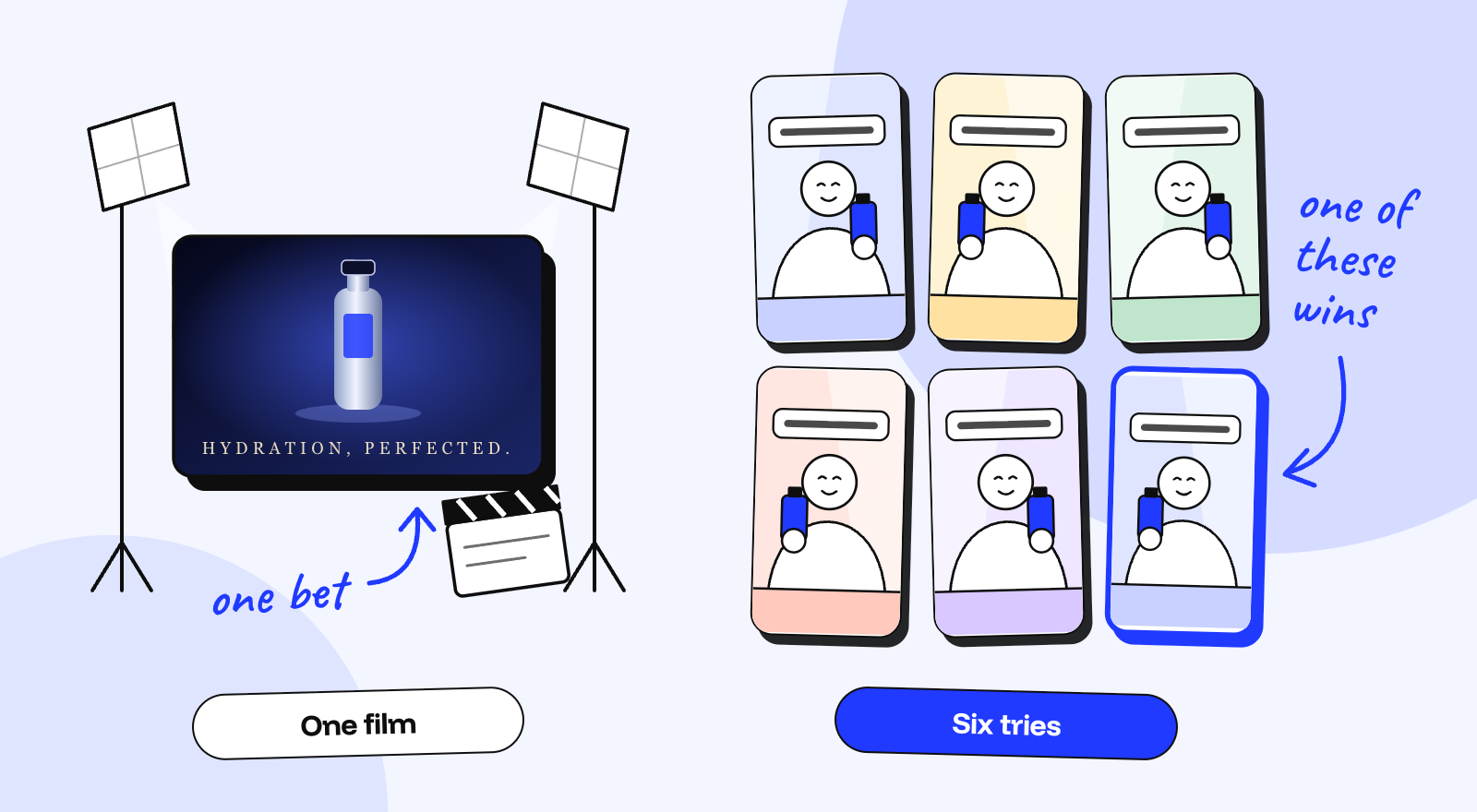
You may have lived a version of this story. The brand film took two days, a crew and a good part of the quarter's budget. Then a creator filmed the same product on her bathroom shelf, on her phone, for a few thousand rupees, and her video brought in the cheaper orders.
This post is for whoever decides where next quarter's creative budget goes. The headline is a strong claim, so we went looking for who has measured it. Here is what we found, including the parts that do not flatter UGC.
The short answer
- Creator-made ads beat brands' usual ads in the platforms' own tests. Meta reports a 19% lower cost per acquisition when partnership ads are added to a campaign. TikTok reports a 70% higher click-through rate for creator ads.
- It is an average, and a few videos carry it. In a study by WPP Media, System1 and TikTok, only 29% of creator ads beat the average brand ad.
- We found no clean test. One studio film against one phone video, same product, same budget. The closest is a Meta and Toluna study of about 100 ads.
- AI has made a real person worth more. In a Gallup survey, 62% of Americans said AI-made people or voices in ads are unacceptable, even when the brand says so.
- UGC is cheap enough to test in numbers. Published rates in India run from ₹1,500 to ₹15,000 a video.
- One video can work in several places: the ad, the product page, the email, the WhatsApp message. Whether that lowers your acquisition cost is something you have to measure.
- Keep the studio for what it is good at: the main image on a marketplace, and the film that tells people who you are.
What we mean by raw UGC and a studio ad
Raw UGC is a short upright video that a paid creator films on a phone, at home, talking to the camera about using your product. Raw describes the style, not the file: it is still cut, captioned and sharp, as we set out in how to edit content that feels native.
A studio ad is the other tradition: a crew, a set, a script, a colour grade. Both are advertising. They differ in how they look between two posts in a feed, and in what they cost to make.
Is raw UGC really outperforming studio ads?
Several groups have measured something close. None put a phone video against a studio film. They compared ads made by creators with whatever the brand was already running.
| Who measured | What they compared | What they found |
|---|---|---|
| Meta (about 2,400 advertisers, June 2025) | Campaigns with partnership ads added, against the usual ads alone | 19% lower cost per acquisition, 13% higher click-through |
| TikTok (content posted February 2024 to January 2025) | Creator ads against non-creator ads, at the same cost per thousand impressions | 70% higher click-through rate, 159% higher engagement rate |
| WPP Media, System1 and TikTok (182,550 users, eight markets) | Creator ads against ads made by brands, on TikTok | Brand memory lift 23% higher on average |
| Meta and Toluna (about 100 ads, four markets) | The best fifth of short video ads against the average | Lower-fidelity, direct-to-camera ads did better than heavily produced ones |
| Kantar, for Google (40 YouTube campaigns, US) | Creator ads with brand ads, against brand ads alone | Aided awareness up 9%, 1.6 times what brand ads did alone |
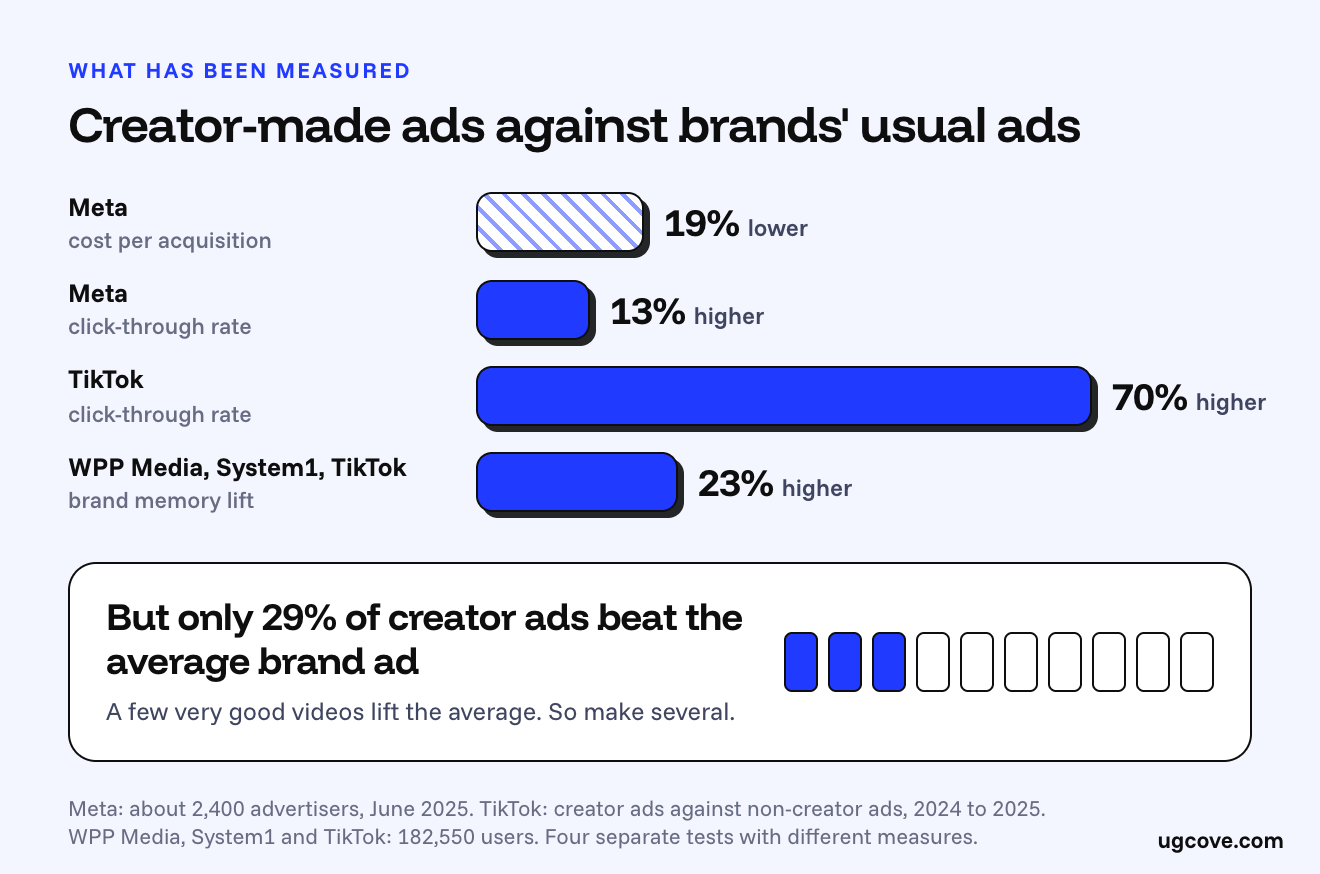
Meta. The figures come from an experiment Meta reported in December 2025. Meta's own small print says performance is not guaranteed.
TikTok. Its analysis says “creator ads drive a 70% higher click-through rate and 159% higher engagement rate than non-creator ads for the same CPM.” It is TikTok's own data with no sample size given, and a click is not a sale.
WPP Media, System1 and TikTok. This is the most careful one, and the most useful. “Creator Ads deliver an average Brand Memory Lift 23% higher than ads produced by brands. However, this advantage is highly concentrated: only 29% of Creator Ads outperform the average brand ad.” So most creator ads lose to an ordinary brand ad, and a few very good ones lift the average.
Meta and Toluna. The nearest thing to rough against polished. “Elements that read as native to the platform, such as emojis, direct-to-camera delivery and lower-fidelity production, outperformed more heavily produced creative.” The same page warns against the lazy reading: “The likely explanation isn’t that audiences prefer lower quality; it’s that native-feeling content signals it belongs in the feed, rather than being an ad interrupting it.” It looked for patterns across about 100 ads, which is not a head-to-head test.
The evidence that cuts the other way
- Looking like a creator is not enough. Zappi, which sells ad testing, studied more than 3,300 social video ads in the US and UK and said in October 2026: “Ads designed to resemble creator content were 30% less likely to be a top performer and had the weakest brand connection of any creative characteristic studied.” Its report separates genuine creator content from brand-made ads built to look like it.
- Most creator content does not build the brand. Kantar looked at more than 15,000 pieces of branded creator content and found that “only 6% of creator content delivers both strong platform engagement and strong brand-building potential”.
- Creators add to brand ads. They do not replace them. That is how the Kantar study for Google sums itself up: “creator authenticity doesn't replace brand advertising - it amplifies it.”
So is the headline true? On average, in tests run mostly by companies that sell the ad space, yes: creator-made ads beat what brands were already running. That is not any phone video beating any film. The fair reading of “outperforming” is that the odds are better and each try is cheaper, so you can afford the tries it takes to find a winner.
Why a real person counts for more in a feed full of AI
The second half of the argument is about what else is in the feed.
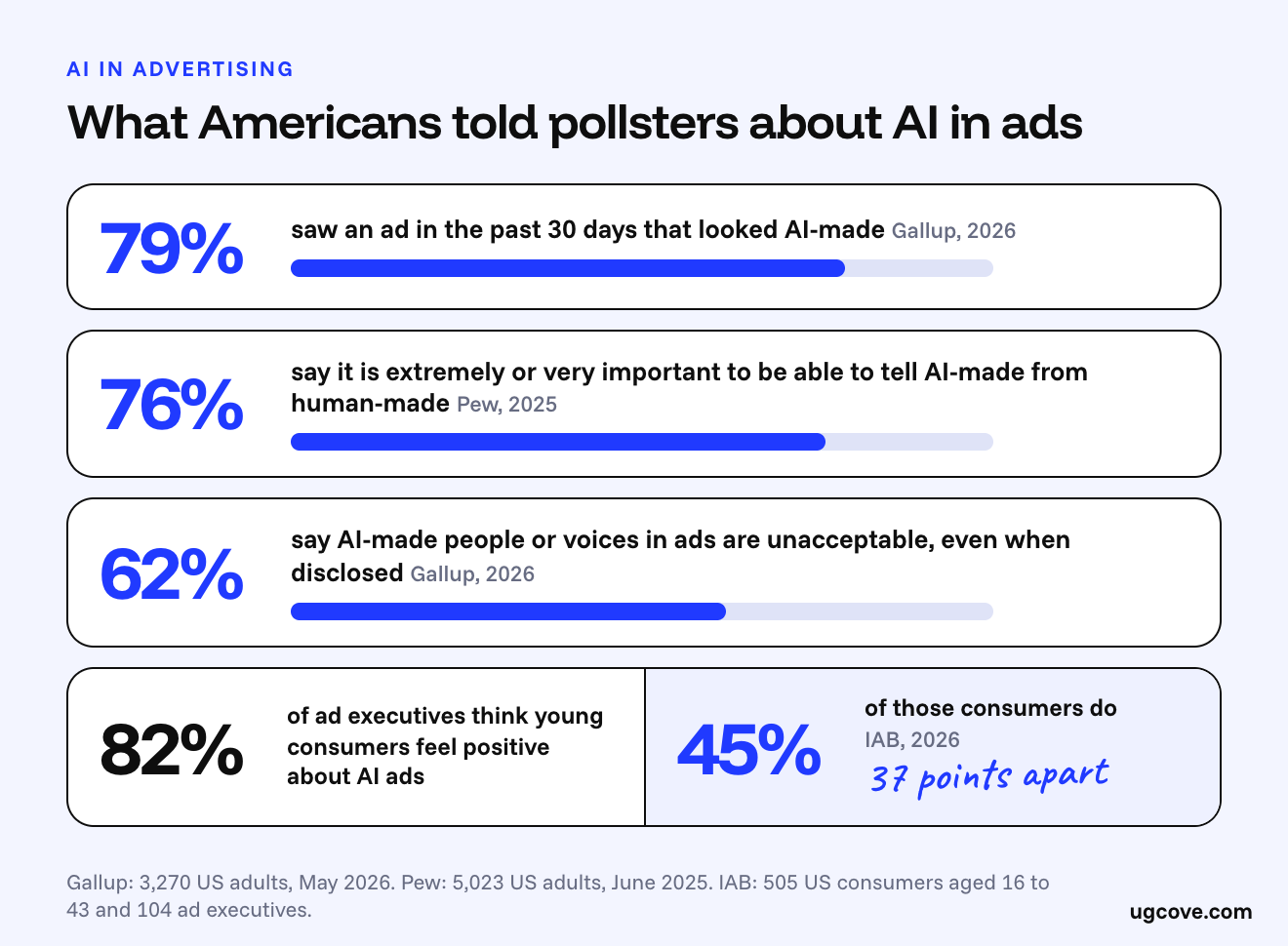
- There is a lot of AI. The 2026 Bentley University-Gallup survey found that “nearly eight in 10 Americans (79%) have seen advertisements in the past 30 days that looked like they were made using AI.” TikTok said in November 2025 that it had labelled “over 1.3 billion videos” as AI-generated.
- People want to know, and doubt they can tell. Pew Research found that 76% of Americans say it is extremely or very important to be able to tell whether pictures, videos and text were made by AI or by people. In the same survey, 53% were not confident that they could.
- They object most to AI people. Gallup again: “Nearly two in three Americans (62%) say that practice is unacceptable, even when businesses clearly disclose that AI was used.” The practice is using AI to create people or voices in ads.
- Advertisers think otherwise. The IAB asked both sides. “82% of ad executives believe Gen Z/Millennial consumers feel very or somewhat positive about AI-generated ads, nearly double the 45% of consumers who actually feel that way.”
What a face can and cannot do
Here the evidence is thinner than the marketing around it. The one large study we found is from 2014: researchers at Georgia Tech and Yahoo Labs looked at 1.1 million Instagram photos and found that those with faces were “38 percent more likely to receive likes”. That is attention, on photos, twelve years ago. We found no study showing that a face or an unpolished look builds trust by itself.
Nor can viewers reliably tell what is AI. Ipsos showed 20 ads to 3,000 Americans in 2026, half made by people and half by AI, and reported: “Only 25% of AI ad viewers were at least somewhat confident the spot was AI-made”. The human-made ads still did better: 14% stronger on short-term effectiveness and 17% on long-term.
AI can copy a messy kitchen. What it cannot honestly supply is a person who had the product in their hands and says what happened. That is the part of UGC worth paying for, and it holds only while it is true. A US survey of more than 3,700 consumers by BBB National Programs found that “70% of consumers feel deceived when they discover a partnership that wasn’t disclosed.”
An AI “customer” is not a cheaper creator
The rules treat the two differently. In the US, the Federal Trade Commission's 2024 rule covers reviews and testimonials “that misrepresent that they are by someone who does not exist, such as AI-generated fake reviews”. In India, ASCI's new guidelines, which take effect in December 2026, say that fabricated endorsements and testimonials “will violate the ASCI code even if an AI label is used.” We went through the prices and the Indian rules in what a UGC video really costs. None of this is legal advice.
What each one costs
In India, published rates for one UGC video run from ₹1,500 to ₹15,000 before ad rights, and our worked example of a five-video test, with ad rights and extra hooks, came to ₹49,500. The detail is in our cost guide.
We could not find a published Indian rate card for a studio-shot ad film, so here is one from the United States, for scale only. Vidico, a production company, puts a “Regional Professional” 30-second commercial at $15,000 to $50,000, and says its figures are “production costs only”. Its simplest local tier starts at $3,000. On the other side, the UGC platform Billo says “most UGC videos cost brands under $500”, before longer usage rights. Both are sellers' estimates. On those numbers, the cheapest regional shoot costs as much as thirty UGC videos.
Volume matters because of how the ad systems now work.
- Meta says its Andromeda system matters “as businesses upload more and more creatives to support a diversification strategy”.
- TikTok is specific: “We suggest between 3-5 different creatives per ad group and 3-5 diversified ad groups per campaign.” And on wear-out: “Having a consistent supply of creatives to refresh is one way to keep your campaigns going.”
Put that next to the 29% figure. If most ads lose and a few win, the brand that can afford ten tries will find a winner more often than the brand that made one film. That is simple arithmetic and not a finding, and it is the strongest case for UGC we can make.
Where to use UGC across the buyer journey
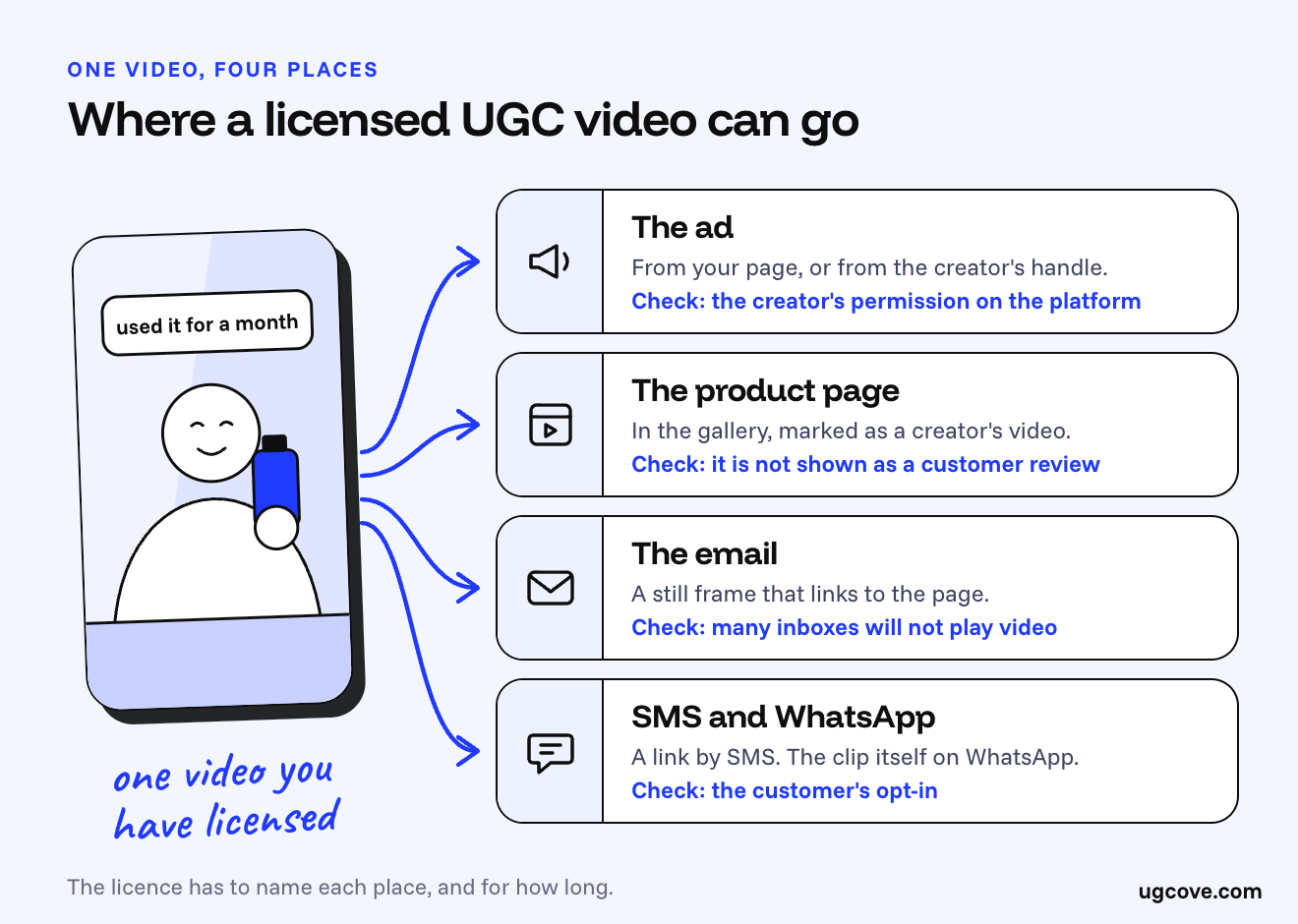
A video you have licensed is not only an ad. The same clip, or a cut of it, can meet the buyer several times before they pay. Here is each stop, with the evidence we could find for it.
The ad
You can run the video from your own page, or from the creator's. Meta calls the second kind partnership ads: “Partnership ads allow you to run Facebook and Instagram ads from a creator or other partner’s handle”. It needs the creator's say-so: “A creator must give permission to a brand to use individual posts as partnership ads.” TikTok's version is Spark Ads, where the creator's authorisation is “defaulted to 365 days”. Creators usually charge more for this.
The product page
This is where the independent evidence is best. Baymard Institute, which tests online shops with real users, found that pictures from past buyers give people “a sense that they are getting more objective, reliable, and trustworthy images of products than those provided by the site”. It also found that “67% of sites fail to offer social media images or videos from past buyers”.
Amazon has a figure for video in general: “product detail pages with their first shoppable video added saw an average 24% increase in sales compared to those without videos.” That is Amazon's internal data, and it is about any product video, not UGC alone.
One caution. Baymard's finding is about real buyers, and a paid creator is not a customer review. Put the video in the gallery, say that it is a creator, and keep it out of the reviews.
The email
We found no published data from the email platforms on UGC in email, so this is practice and not proof. Do not count on the video playing in the inbox. Can I email, a site that tests email apps, lists Gmail, Yahoo Mail and Outlook on Windows as not playing video. Use a still frame with a play button, and link it to the product page where the video does play.
SMS and WhatsApp
A plain text message carries words and a link, so the link has to lead somewhere the video plays. WhatsApp can carry the clip itself: “A media header allows you to add an image, video, GIF, or document at the top of your WhatsApp template message.” A ten-second cut of the creator answering the question buyers always ask suits it.
Consent comes first. WhatsApp's rule is short: “Businesses are required to obtain opt-in before messaging people on WhatsApp.” Marketing texts have their own rules in most countries, so check with your messaging provider before you send.
Does UGC lower customer acquisition cost?
Customer acquisition cost, or CAC, is everything you spend on marketing and sales to win new customers in a period, divided by the number of new customers you won. The cost of making the ads belongs in it.
The pressure on it is real. Meta's results for July to September 2026 say “Average price per ad increased by 14% year-over-year.” That is an average across all of Meta and not your own rate, but the direction is plain. When showing an ad costs more, CAC falls only if more viewers buy or the ad costs less to make. UGC can work on both.
Now the limit. We found no one who has published the whole chain, with the same videos used at every stop and CAC measured before and after. Every figure here covers one stop, and most come from the company that sells it. So what follows is only a sum.
The sum (ours, not a study). Say you spend ₹3,00,000 on ads and ₹50,000 on creative in a month and win 500 new customers. Your CAC is ₹700, and each order costs ₹600 in ads. If adding creator ads brought that ₹600 down by Meta's average of 19%, to ₹486, the same ad money would win about 617 customers. With creative still at ₹50,000, CAC would fall to about ₹567. That “if” is the whole question, and the test at the end of this post is how you answer it.
Where a studio shoot still wins
- The main image on a marketplace. Amazon's guide for sellers says: “In most cases, product shots should be taken against a white background (RGB color values: 255, 255, 255).” Google's rule for shopping listings is “Don’t use an image that contains promotional elements or overlays”. A frame from a creator's video will rarely pass either.
- The film that says who you are. A launch, a TV spot, a brand whose appeal is polish. Creator ads worked best beside brand advertising in the Kantar study above.
- A weak idea. Nielsen's 2017 study of nearly 500 campaigns put it this way: “weak creative results in weak sales lift”. Filming a weak idea on a phone does not fix it.
So split the budget, and do not swap one for the other. Keep the pack shots and one film, and move the testing budget to creators.
Before you reuse a video: rights and rules
- The licence has to name each place. Ads, product page, email and messages are four uses. Write each into the brief, with the period, before anyone films.
- Platform permission is separate. An ad from the creator's handle needs their approval on the platform too, and on TikTok it runs out.
- The disclosure travels with the video. The FTC's guidance: “Each new endorsement made without a disclosure could be deceptive because viewers might not have seen the prior posts.” A paid video in a new place has to be clear, there too, that it was paid for.
These rules differ by country, and this is not legal advice.
How to start: a first UGC test
- Pick one product, the one you already spend the most to advertise.
- Write down last quarter's CAC, with creative costs in it. Leave them out and the studio looks cheaper than it is.
- Brief five creators, two openings each. That is ten ads to compare, for about ₹50,000 in our worked example. Send points, not a script. The 3-second rule explains why the openings matter.
- Buy the rights you will use. Name the ads, the product page, the email and the messages, and the months.
- Run them next to your usual ads, not in place of them. Same product, same budget, for six weeks. A small account can swing either way in one.
- Compare CAC, not clicks. Then put the winner on the product page, and go back to the creator who made it.
Where UGCOVE fits
This is what we are building UGCOVE for. You write the brief in your own words, and creators in India and Thailand apply at their own rate. That rate covers what your brief asks for, including the usage rights and two rounds of changes, and you see it, along with our fee, before you confirm. Your payment is held until you approve the video, and the written licence comes with the file. How it works has the whole journey.
We are not open yet. Brands are being let in in small groups, and the waitlist hears about launch pricing first.
FAQ: raw UGC and studio ads
Is UGC better than studio ads?
On average, in the platforms' own tests, creator-made ads beat the ads brands usually run: Meta reports 19% lower cost per acquisition and TikTok a 70% higher click-through rate. In one large study only 29% of creator ads beat the average brand ad, so plan to make several.
How much cheaper is UGC than a studio shoot?
Published rates in India run from ₹1,500 to ₹15,000 a video before ad rights. We found no published Indian price for a studio ad film. In the US, one production company puts a regional 30-second commercial at $15,000 to $50,000, against under $500 for most UGC videos.
Does UGC lower customer acquisition cost?
It can, by lowering what the ad costs to make and by raising how many viewers buy. We found no published measurement across the whole buyer journey, so test it: UGC next to your usual ads, same budget, six weeks, creative costs counted.
Can I use AI-generated UGC instead of real creators?
You can use AI in ads, but an AI “customer” who never used the product is a different thing. Gallup found that 62% of Americans think AI-made people or voices in ads are unacceptable even when disclosed, and the FTC's rule, and ASCI's guidelines from December 2026, are against fabricated testimonials.
Can I use a UGC video on my product page, in email and on WhatsApp?
Yes, if your licence names each use. On the product page, show it as a creator's video and not as a customer review. In email, link a still frame to the page. On WhatsApp you need the customer's opt-in first.
The pages quoted in this post were read on 25 November 2026. We will update it when they change.