How to become a UGC creator with no followers (step by step)
You can get paid to film product videos without an audience, because the brand posts the video, not you. Here are the seven steps, with the parts most guides leave out: which platforms accept your country, what they take from your pay, and the offers to walk away from.
On this page
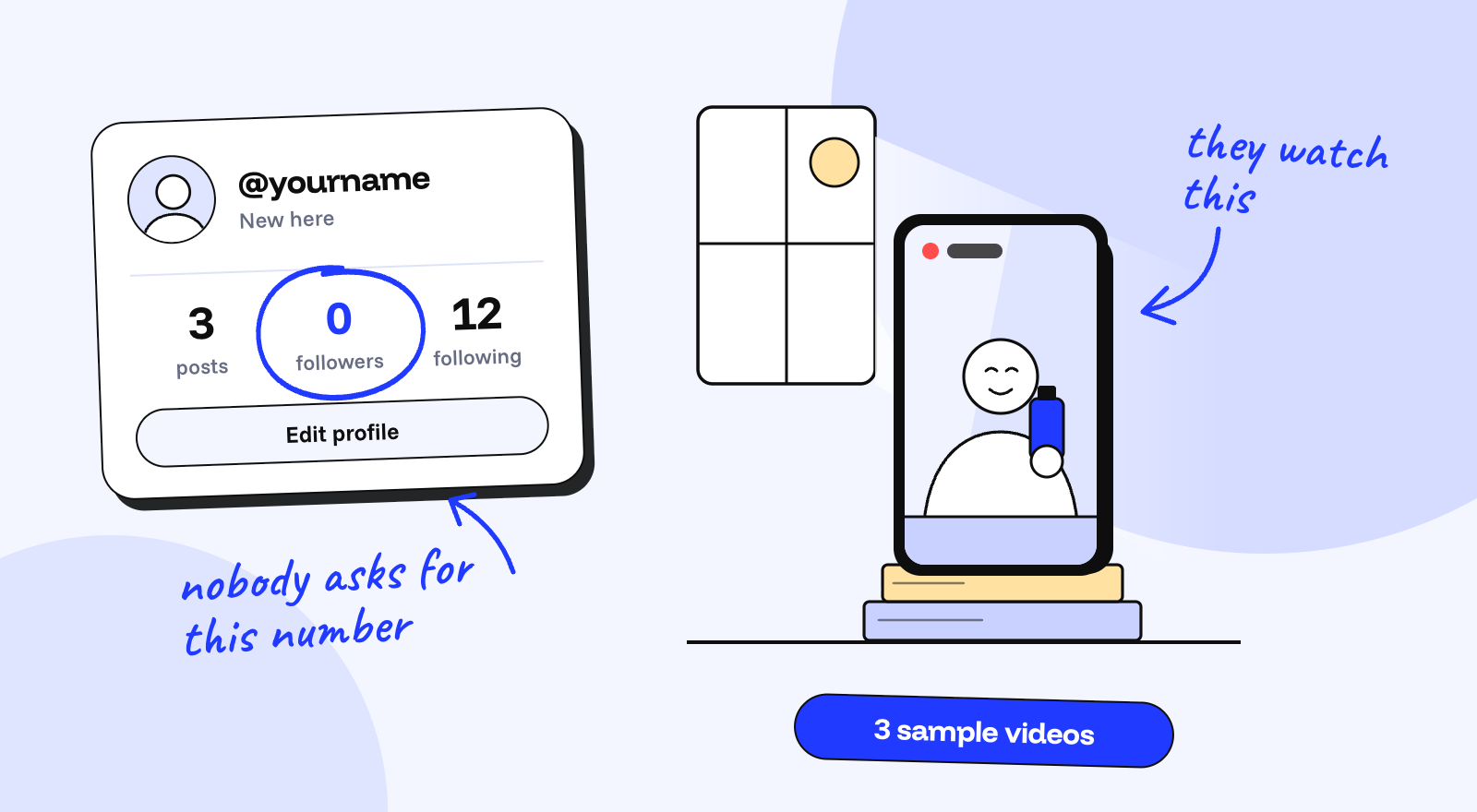
A UGC creator is paid to film a short video about a product. The brand then posts that video on its own account, or runs it as an ad. Your followers never see it, which is why you do not need any.
Most guides stop there. What they leave out is that many of the well-known platforms only accept creators from a handful of countries, that several take a cut of your pay, and that nobody independent has measured how long the first job takes. This guide has the seven steps and those missing parts.
The short answer
- Yes, you can start with no followers. Billo, Twirl and Influee say so on their own pages, and UGCOVE has no follower minimum either. Brands judge your sample videos.
- You need a phone, a window, a quiet room and three sample videos. The samples can be about products you already own. None of the sign-up pages we read asks whether they were paid work.
- Check the country list before the application form. Billo takes creators in the US, the UK and Canada only. JoinBrands takes five countries. Most of the world has to look elsewhere or pitch brands directly.
- Expect a small first rate. On Collabstr, brands paid $154 on average for a UGC job in 2025. Billo's blog puts entry-level pay at $50 to $150 a video.
- Never pay to get a job. A deposit, a starter kit or a refund of an “overpayment” is how a scam starts, not a job.
Can you become a UGC creator with no followers?
Yes. In a typical job the brand pays for the video and the right to use it, then shows it to people the brand has chosen. Your audience is not part of the deal. We went through the difference in our post on UGC creators and influencers.
This is what the platforms' own pages say:
- Billo: “No professional experience or social media presence is required.”
- Twirl: “The number of followers you have does not impact your eligibility to work with a brand.”
- Influee: “No follower count required.”
- JoinBrands, on its content-only jobs: “You do not need to post anything on your own accounts.”
There are places where the number does count. TikTok One, TikTok's marketplace for brand deals, says creators need “at least 1,000+ followers” to take part in projects, and another of TikTok's help pages puts the bar at 10,000. Meta's Creator Marketplace on Instagram asks for “a minimum of 1,000 followers”. Insense asks for “at least 1,000 followers and 1,000 views on Instagram and TikTok”, with a separate UGC-only route for people it turns down on those numbers. All three are built around creators who post on their own accounts. You can leave them for later.
What you need before you start
- A phone, a window and a quiet room. Daylight from a window in front of you, and a room with soft things in it so your voice does not echo.
- To be 18. Billo, Twirl, Collabstr and Meta's Creator Marketplace all set 18 as the minimum, and so do we. Fiverr lets people aged 13 to 17 work only “through an account owned by their parent or legal guardian, with permission”.
- Products you already own. You will film these first, so pick things you have used for a while and have opinions about.
- No money. Billo, JoinBrands, Insense, Influee, Collabstr and Upwork all say it costs nothing to sign up. A course is optional. A fee to get a job is a warning sign, and there is more on that below.
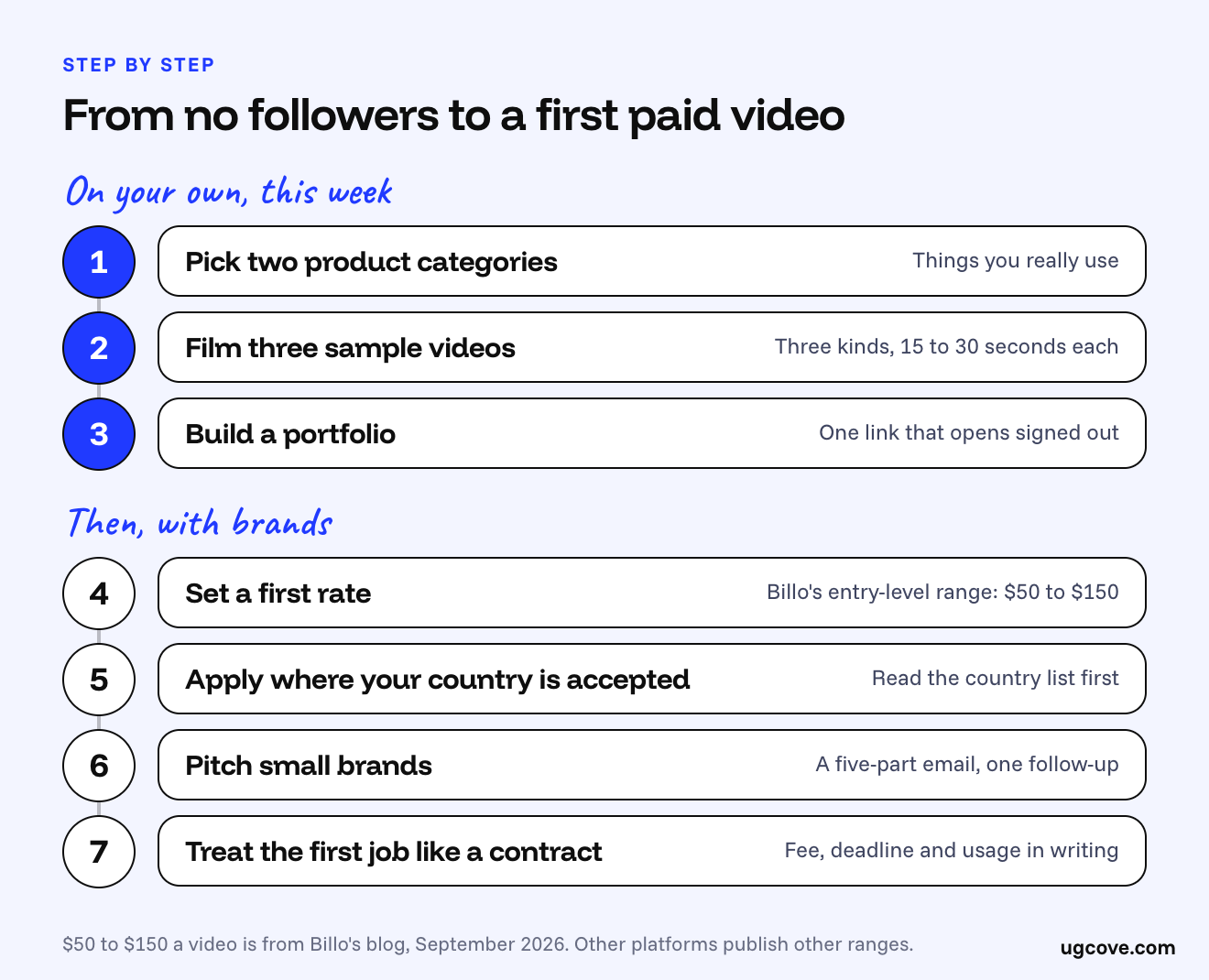
Step 1: Pick two product categories you really use
A skincare brand will find it easier to believe someone who has a skincare routine, and a pet food brand someone with a dog. So start from your own shelves: skincare, cooking, fitness, baby things, tech, pets, cleaning, coffee. Pick two categories where you could talk for a minute without a script.
Two is not a random number. One line of Insense's checklist for its UGC-only route reads: “Content featuring at least 2 different product categories”. And a kitchen brand learns little from three skincare videos.
There is also a rule behind this step. The US Federal Trade Commission tells creators, in its guide to disclosures: “You can’t talk about your experience with a product you haven’t tried.” India's Department of Consumer Affairs says much the same: “Individuals must not endorse any product or service that they have not personally used or experienced”. If you pick categories you really use, you will never have to pretend.
Step 2: Film three sample videos
A sample is a video you make with no client, to show how you film. Make three, of three different kinds, so a brand sees three skills and not one skill three times:
- An unboxing or first look. It shows your light and how you handle a product.
- A piece to camera. You, talking about something you have used for at least a month. It shows how you sound.
- A problem, then the product. It shows that you can tell a small story in 20 seconds.
Keep each one between 15 and 30 seconds, shoot it upright, and spend most of your effort on the opening. Our post on the three-second rule explains why, and ten practice briefs gives you ready-made exercises.
If you do not want to show your face, you can film hands and product with your voice over the top. That is real work that brands buy. It will not get you in everywhere, though. Insense's checklist asks for “Examples of both on-camera speaking and voice-over content”, and Billo's application is a video pitch of up to 30 seconds in which you introduce yourself.
Leave the files clean: no filter, no editing-app logo on the end, no chart music. And do not label a practice video as an ad or thank a brand that did not send you anything.
Step 3: Build a UGC creator portfolio a brand can open in one tap
A portfolio is one link that holds your samples. It does not need to be a website. Backstage, the casting site, puts it this way: “Many creators build simple portfolios using Canva, Notion, Beacons, Google Drive, or a basic website.” Billo's blog says a “link-in-bio page, a Canva-built PDF, or a dedicated website” will all do. Put in it:
- Two lines about who you are and the two categories you film.
- Your three videos, best one first. Assume the brand watches one of them, and not to the end.
- The kinds of video you make: unboxing, testimonial, demo, voiceover.
- How to reach you, and how fast you deliver.
Then open the link on a phone, in a private browser window where you are signed out. If it asks for a login or a download, a busy marketing manager will close it.
How many videos? Three is enough to start applying. Backstage's list says: “Three to six of your strongest sample videos”. Insense, whose help centre lists what its UGC-only application needs, sets the bar higher: “At least 6–12 videos”. So start with three and add one a week.
Step 4: Set your first rate
There are real numbers for this, though fewer than the internet suggests. The largest set we found is Collabstr's 2026 report, which covers more than 21,000 collaborations on its marketplace in 2025. Creators asked $180 on average for a UGC job, and brands paid $154 on average. In Influencer Marketing Hub's 2026 survey of marketers, “roughly 80% of all responses” on what a UGC creator costs were under $500.
Those are averages across everyone. For beginners, the platforms' own pages are a better guide:
- Billo's blog says entry-level creators with a basic portfolio “typically earn $50 – $150 per video”.
- JoinBrands sets a default of $60 for a UGC video in its US marketplace, and a floor of $50, before its 20% fee on regular jobs. On a $60 job you would keep $48.
- Twirl says its pay “usually ranges from $130-$300+ USD per project”.
These are US-dollar figures from platforms that mostly serve the US and Europe. Local rates differ a lot. For India, we added up the published prices in what a UGC video really costs.
On some platforms you do not set the rate for a standard video at all. Billo tells creators: “No, you can't negotiate your rate. Each task has a set payout, which is visible before applying to the task.” On others, such as Collabstr and Vidovo, you name your own price, and on UGCOVE you will too.
Our suggestion, where you get to choose: start inside the published beginner range for your market, and raise it after your first three to five paid jobs. Price one video filmed to a brief, with a fixed number of changes. The right to run it as a paid ad, extra openings and the raw footage are extras, and we would price them separately.
Step 5: Apply where your country is accepted
Most guides skip this step, and it decides where your time goes. This is what each platform's own pages said when we read them:
| Platform | Countries it takes creators from | Followers | What it takes from your pay |
|---|---|---|---|
| Billo | US, UK or Canada | None needed | No fee stated. Each task has a set payout. |
| JoinBrands | US, UK, Canada, Australia or Germany | Not needed for content-only jobs | 20% of regular job earnings |
| Twirl | Mainly UK, US, Germany, France, Italy, Spain and the UAE | None needed, unless a brief asks | Nothing: it “does not take a percentage” |
| Insense | 22 countries, mostly in Europe and North America | 1,000, or the UGC-only route after a rejection | No fee stated |
| Influee | “30+ countries”, in the Americas, Europe and Australia | None needed | Not stated |
| Collabstr | “over 35 countries” | No minimum stated | 15% of each sale |
| Fiverr | No country list found | None | 20% |
| Upwork | No country list found | None | 0% to 15%, plus paid credits to apply |
| UGCOVE (not open yet) | Anywhere | None | Any fee on your side is shown before you apply |
Do not sign up from a country that is not on the list. JoinBrands is plain about what happens. The account is flagged during verification, and: “Payments may fail to process.”
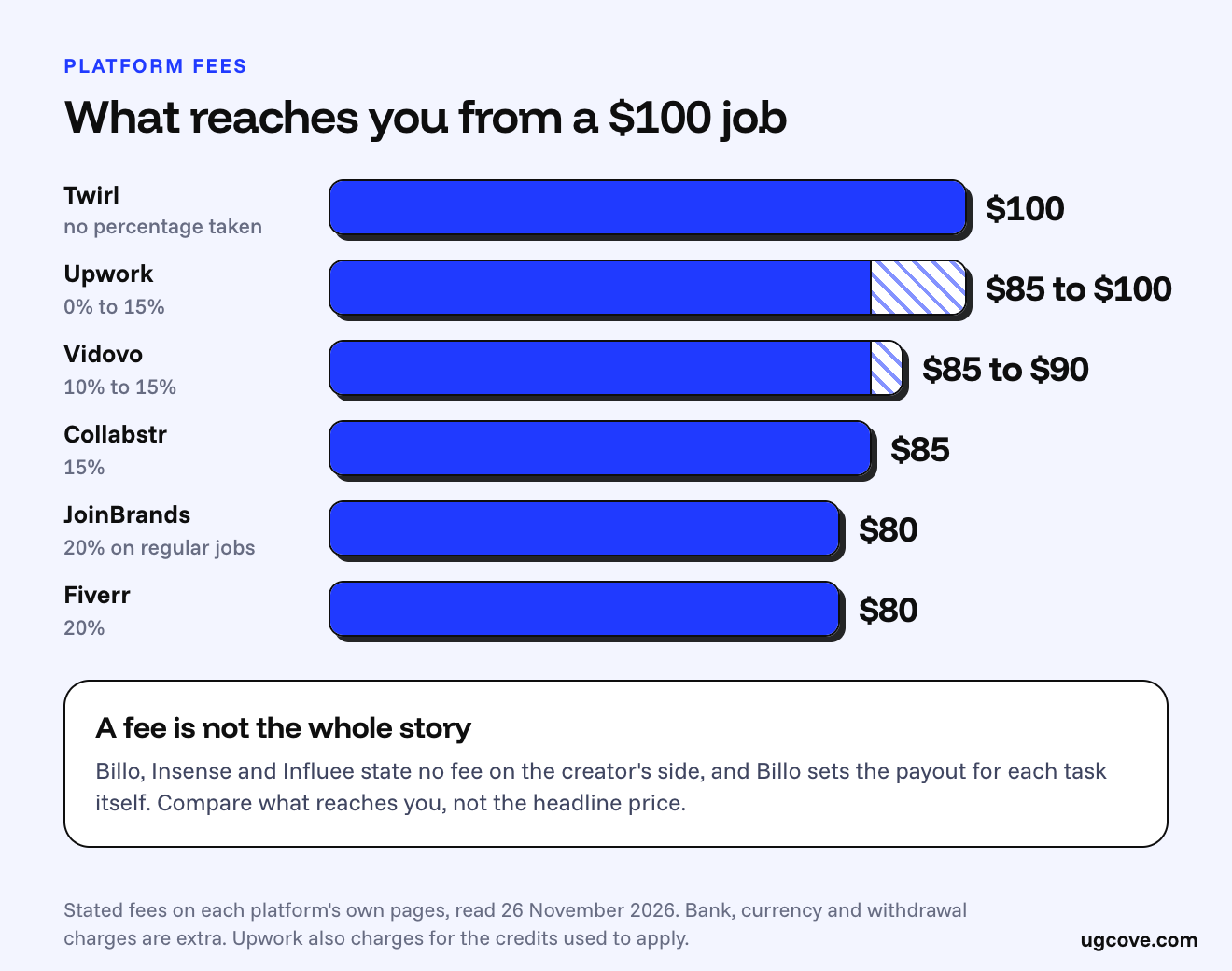
A fee is not a reason to avoid a platform, since it also finds you the work and holds the brand's money. It is a reason to know your real rate. Upwork also charges to apply: its credits, called Connects, cost $0.15 each, and each proposal uses some.
If nothing on the list takes your country, you are not stuck. Fiverr and Upwork are general freelance marketplaces, and we found no short country list on either. And the next step works from anywhere.
Step 6: Pitch small brands yourself
Many of the buyers of this kind of video are small. Collabstr's report says: “Over 40% of UGC campaigns come from companies spending less than $5k.” So look for small brands in your two categories: ones that already run video ads, sell online, and have a founder or marketing manager you can find by name.
They hear from fewer creators than you would think. In a study by impact.com, which sells software for creator partnerships, 42% of brands said fewer than five creators approach them in a week, and 52% preferred to be approached by email. The page does not give the size of the study, so treat it as a hint.
A pitch that works is short. Backstage's list for a first pitch comes down to five parts:
- One line on who you are.
- Why you like this brand in particular. Mention a product you own.
- “One or two content ideas”, as concrete as you can make them.
- The link to your portfolio.
- One clear ask, such as “could I send you a quote for three videos?”
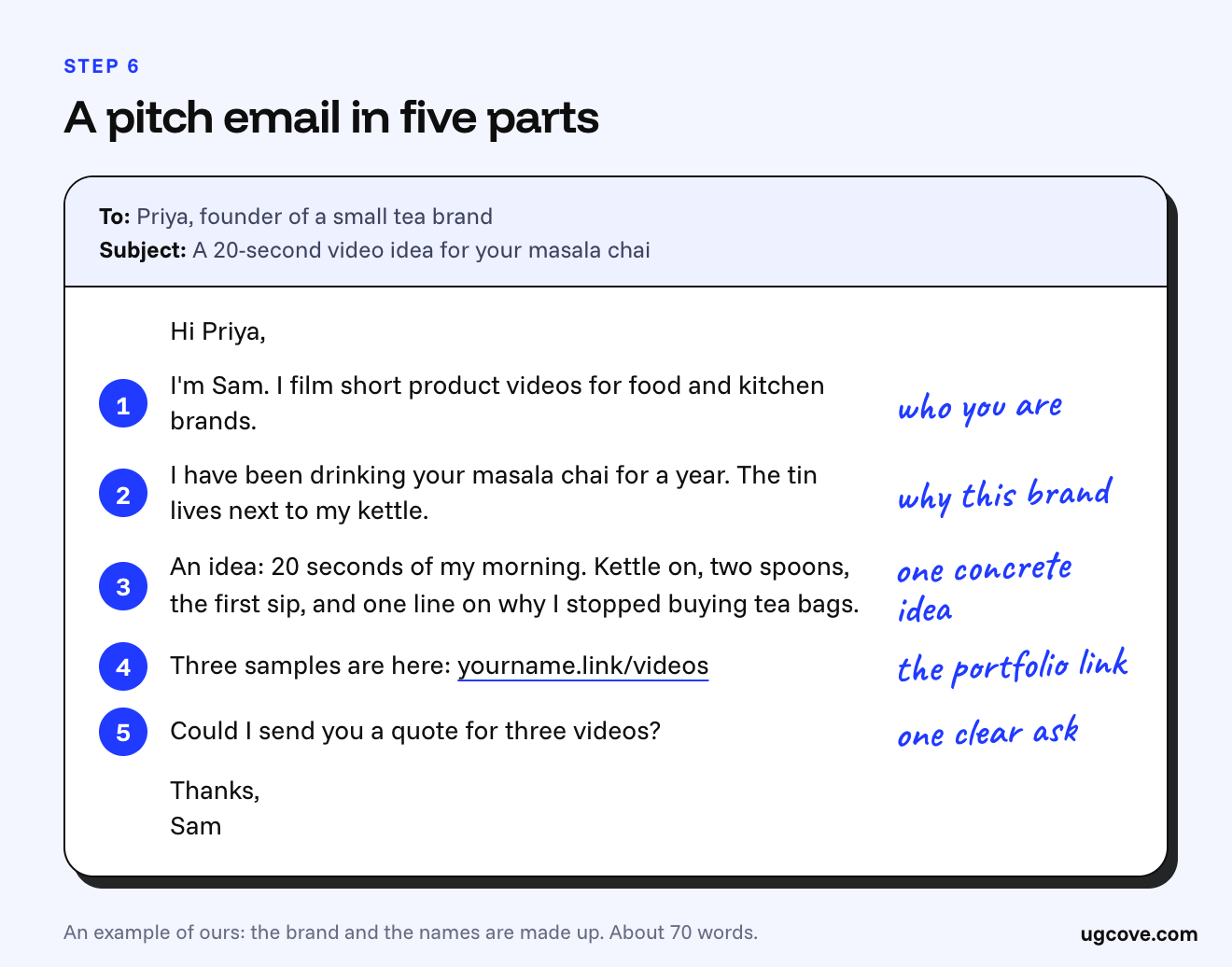
Send it to a person, not to info@. Link to your videos and do not attach them. If you hear nothing, follow up once after about a week, then move on. Silence is the normal result of a cold email and says nothing about your videos.
Step 7: Treat the first job like a contract
When a brand says yes, slow down for ten minutes. The Freelancers Union gives freelancers a rule that fits in five words: “Put everything important in writing.” It does not have to be a formal contract to be useful: an email that both of you have replied to gives you something to point to. It should say:
- What you deliver: how many videos, how long, upright or square, with or without captions.
- The deadline, and whether it counts from the day the product arrives.
- How many rounds of changes are included. Every UGCOVE brief includes two.
- The fee, and the date it is paid. On many platforms the brand's money is held until you deliver. Off a platform, ask for part of it before you film.
- Where and for how long the brand may use the video. On its own pages only, or as a paid ad as well? For three months, or for ever?
- Whether the ad may run from your handle. This one is separate, and it needs your permission.
On that last point the platforms back you up. To run a TikTok ad from your account, a brand needs a code that you generate, and you choose “the authorization duration (7, 30, 60, or 365 days)”. On Instagram, “advertisers need permission from the partner whose handle the ad will include”, and creators “can revoke these permissions at any time”. So when a brand asks for a code, it is asking for something extra, and you can limit it to one post and a set number of days.
Then film what the brief asks for, send it on the day you said, and take the notes without arguing. Our post on editing a video so it feels native covers the edit itself.
How long does it take to get the first paid job?
We looked for independent data on this and found none. The guides that rank for this question promise a first deal in anything from one week to eight, and none of them shows where the number comes from. Here is what has been published:
- Billo tells its new creators: “On average, it takes around 30 applications to get approved for your first task”.
- Vidovo says of people applying to join it that “about 1 in 10 applicants is approved”.
- Influee says on its creator page: “83% of new creators secure their first paid project within 14 days of joining Influee.” That is its own figure, about creators it has already let in.
- Hunter, an email software company, analysed 11 million cold emails for its 2025 report. It reports that “the average reply rate to a campaign is 4.1%”.
None of those is an independent study of new UGC creators. Together they suggest the honest plan: count applications in tens, not in ones. If you send five pitches and apply to five jobs a week, a month gives you forty tries, which is a fair first test.
If a month passes with no reply at all, change one thing and go again. Swap the first video in your portfolio. Rewrite the first line of the pitch. Pick smaller brands. Add a second category.
Scams and bad offers to walk away from
People looking for online work are a target. In its review of 2024, the FTC says reports of job scams and fake employment agencies nearly tripled between 2020 and 2024, and that losses “grew from $90 million to $501 million”. Those are US figures, but the tricks travel. These are the ones a new creator is most likely to meet:
- Paying to get the job. A deposit, a starter kit, a “verification fee”. The FTC's line is: “Honest employers, including the federal government, will never ask you to pay to get a job.”
- The overpayment. A “brand” sends too much and asks for the difference back. The first payment then bounces. The FTC again: “No honest potential employer will ever send you a check to deposit and then tell you to send on part of the money”.
- Buy it first, we will refund you. From a stranger, off any platform, this is a way to sell you a product, or worse. We would only buy to be reimbursed where a platform holds the brand's money.
- Tasks for pay. Liking videos or rating products in an app, until you have to deposit money to withdraw your “earnings”. The FTC says this kind of scam “typically starts with an unexpected text or WhatsApp message offering online work but no specifics”.
- The brand deal email with a file to open. YouTube's advice to its creators works for everyone: before replying, “verify legitimacy by calling the company on the phone”. We would add: find the contact address on the brand's own website and write to that.
One offer is not a scam and still deserves a pause: a free product in place of a fee. It can be a fair swap for a first sample with a real brand, as long as the brand does not get paid-ad rights for a bottle of shampoo.
The rules: honesty, ad labels and tax
Say only what is true for you
Use the product before you film it. Do not read out a claim you cannot know, such as a medical result, just because it is in the script. The FTC's guide says a creator cannot make up claims “that would require proof the advertiser doesn’t have”. If a brief asks you to say you have used something for months and you have not, ask to change the line.
Label it when you post it yourself
In a typical job the video goes out from the brand's account, as the brand's advertising. If you also post it on your own account, the disclosure rules apply to you, and a free product counts as payment. The words differ by country:
- US: the FTC says “it’s your responsibility to make these disclosures”, in the video itself and in words that are hard to miss.
- UK: the competition regulator's guidance says a post you were paid or given something for “must be clearly labelled as an advert or ad”, and that this applies “no matter how many followers you have”.
- India: the advertising standards body, ASCI, allows a fixed list of labels: “#Advertisement, #Ad, #Sponsored, #Collaboration, #Partnership, #Employee, #Free gift.”
Keep a record for tax from the first payment
We are not tax advisers, and the rules differ in every country. The amounts at which they start can be lower than you would guess. Two examples, in the tax offices' own words:
- US: the IRS says you must pay self-employment tax if your net earnings from self-employment “were $400 or more”. From 2026, a brand has to file a Form 1099-NEC for you only once it has paid you “at least $2,000” in the year, so the form may never arrive. The income counts either way.
- UK: GOV.UK says “you must register for Self Assessment as a sole trader if you earn more than £1,000 in a tax year”.
So from day one, keep a simple sheet: date, brand, amount, platform fee, and what you spent on products. Then look up the rule on your own tax office's website.
Where UGCOVE fits
We are building UGCOVE for exactly this starting point. There is no follower minimum, and creators aged 18 or over can apply from anywhere in the world. You apply with links to three sample videos, which do not have to be paid work, and a person on our team watches every set. You set your own rate. The brand pays up front, we hold the money, and it is released when the brand approves your video. Two rounds of changes are included in every brief, and you see the usage terms before you accept. How it works has the whole journey.
We are not open yet. Creators on the waitlist hear first.
FAQ: becoming a UGC creator
Can you be a UGC creator with no followers?
Yes. The brand posts the video or runs it as an ad from its own account, so your audience is not part of the job. Billo, Twirl and Influee say on their own pages that no following is needed. Marketplaces built for creators who post themselves, such as TikTok One and Meta's Creator Marketplace, ask for 1,000 followers or more.
Can I become a UGC creator with no experience?
Yes. Billo's creator page says: “No professional experience or social media presence is required.” What you need is proof that you can film: three sample videos about products you already own.
How much do beginner UGC creators make?
Billo's blog puts entry-level pay at $50 to $150 a video, and Twirl says its projects usually pay from $130. On Collabstr, brands paid $154 on average for a UGC job in 2025, across creators of every level. We found no independent figure for monthly earnings in the first year.
Can I be a UGC creator without showing my face?
Yes, with hands, product and voiceover. Some platforms still want to see or hear you: Insense asks for both on-camera speaking and voiceover samples, and Billo asks for a video pitch of up to 30 seconds.
Do I have to post the videos on my own account?
Usually not. The brand posts them. If a brand wants you to post as well, or to run the ad from your handle, that is extra work with its own price.
How old do you have to be to be a UGC creator?
Eighteen on the platforms we checked that state an age, including Billo, Twirl, Collabstr and UGCOVE. Fiverr allows people aged 13 to 17 only through a parent's or guardian's account.
Is it free to become a UGC creator?
Yes. Billo, JoinBrands, Insense, Influee, Collabstr and Upwork all say it costs nothing to sign up, and you can film with the phone and the products you have. Some platforms take a share of each job, up to 20%. Never pay a fee to get a job.
The pages quoted in this post were read on 26 November 2026. We will update it when they change.