Vanity metrics are dead: what brands actually look for in a UGC creator
You have 200 followers and you think no brand will pay you. That is true for an influencer and wrong for a UGC creator. Here is the difference, what brands look at instead of your follower count, and the few times the number still matters.
On this page
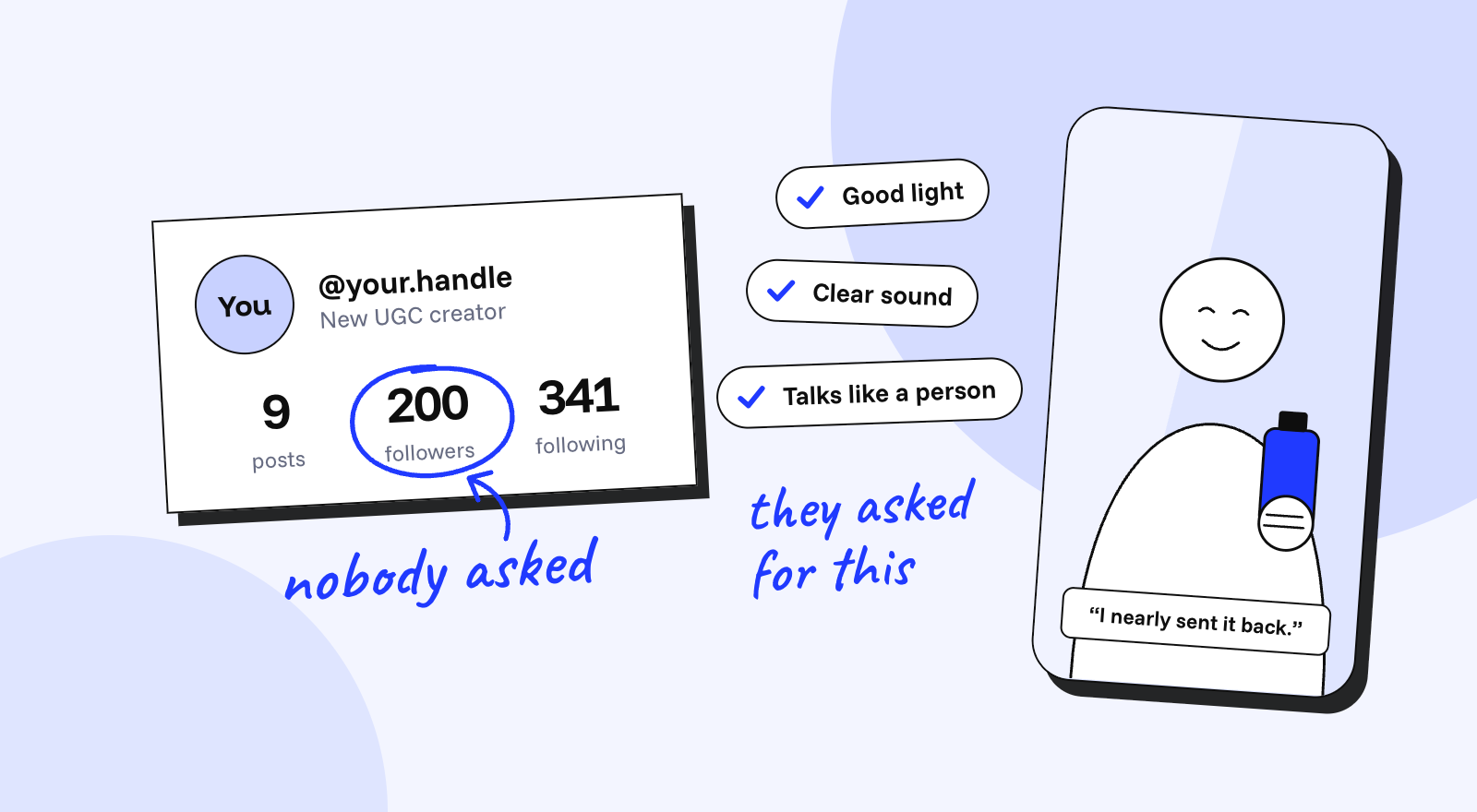
You have 200 followers. Forty of them are family, and one is a shop that sells phone cases. So you have decided that no brand is going to pay you to make a video.
For an influencer, that would be right. For a UGC creator it is wrong, because a UGC creator is not selling an audience. In UGC, the vanity metrics are dead: followers, likes, views on your own page, all of it. This post is about the difference between the two jobs, why those numbers stop counting in one of them, and what brands look at instead.
The short answer
- An influencer is hired for the audience. The brand pays to reach the people who follow them, so the number is the product.
- A UGC creator is hired for the video. The brand takes the file and posts it on its own page, or runs it as an ad. Your followers do not see it, unless the brand asks to use your handle.
- So the follower count stops mattering. Billo, Twirl, JoinBrands and soona all say in writing that a UGC creator does not need a following. So do we.
- What brands look at is the video. Light, sound, the first three seconds, how you talk, and whether the product is in the frame.
- The number comes back in a few cases. Mostly when a brand wants to run the ad from your handle and not its own. More on that below.
UGC creator vs influencer: what is the difference?
Both of them film a product on a phone, and the two videos can look identical. The difference is what happens to the video next.
Billo's blog puts it in two sentences: “A UGC creator produces content that a brand uses on its own channels.” And: “An influencer, on the other hand, creates and publishes content to their own audience.” Insense is blunter. In its words, “an influencer's value is their audience.”
So the brand is not after your reach. It is after footage that looks at home in a feed: raw, shot on a phone, a real person in a real room. A brand cannot easily make that itself. The moment its own marketing team films it, it looks like an advert.
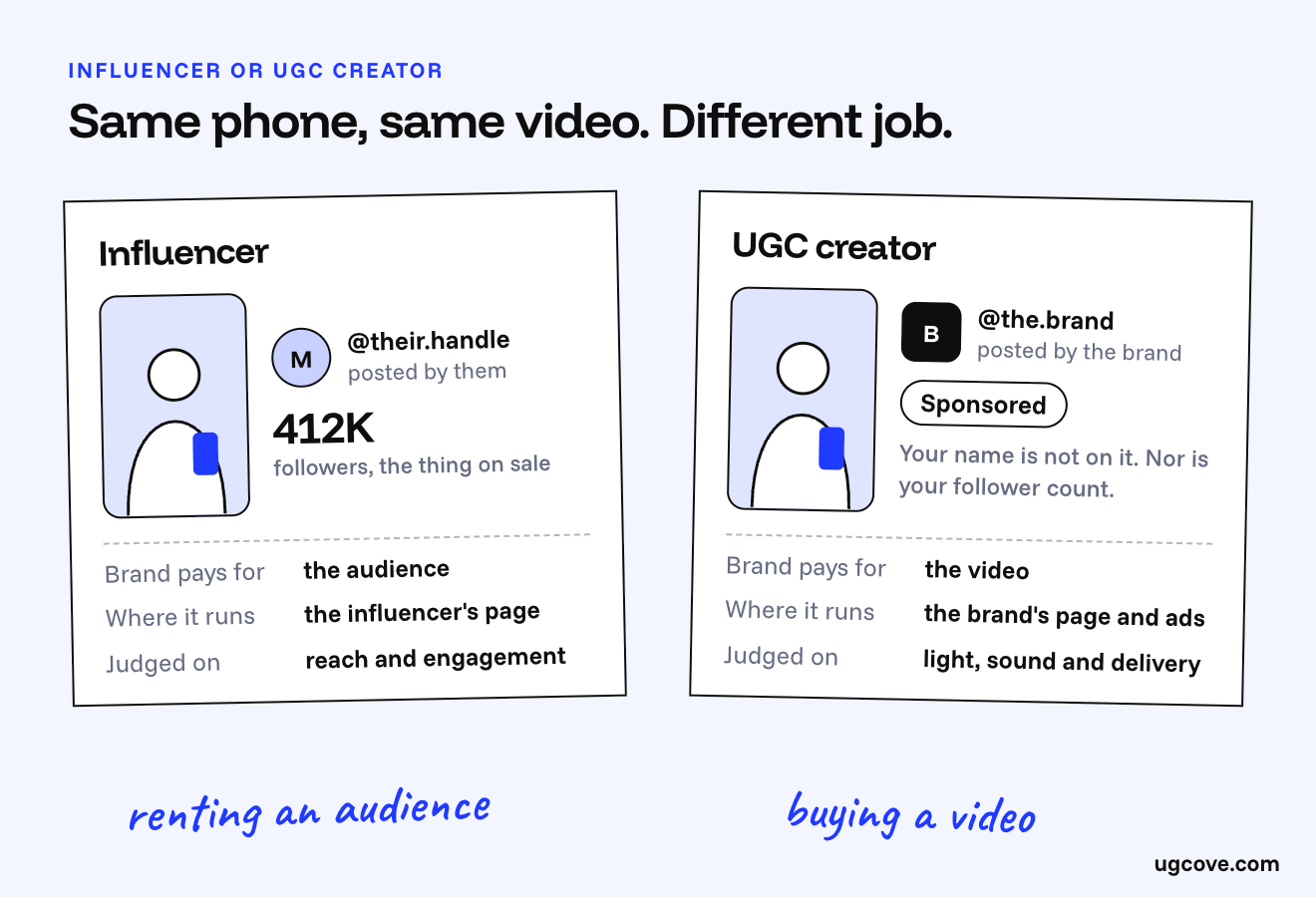
| The question | UGC creator | Influencer |
|---|---|---|
| What the brand pays for | The video, and the right to use it | Reach: their followers |
| Who posts it | The brand, often as an ad | The influencer |
| What sets the price | The work and the usage rights | Mostly audience size |
| What you are judged on | How the video looks and sounds | Followers and engagement |
| What you need to start | A phone, a window and a few sample videos | An audience, which takes a long time to build |
You can see it in the prices. The same Billo article puts UGC at $100 to $500 a video, and an influencer post anywhere from $50 to more than $25,000 “depending on tier”. A tier, in influencer marketing, is a band of follower counts. One job is priced by the work and the other by the crowd.
Plenty of people do both. They are still two jobs, and only one of them needs followers.
Do you need followers to be a UGC creator?
No. You do not have to take a marketplace's word for it, ours included. Here is what the platforms say on their own pages, as read in November 2026.
- Billo: “No following required to start”.
- Twirl: “You do not need a following on your public social media pages to collaborate with brands on Twirl.”
- JoinBrands: “The brands running campaigns on JoinBrands are not filtering creators by follower count.”
- soona: “As a UGC creator, you don't need a specific number of followers to get paid.”
- Insense (the UGC-only route): asks for a portfolio of 6 to 12 videos, and does not ask you to post anything on your own accounts.
- UGCOVE: no follower minimum. We ask for links to three sample videos.
Every company on that list wants creators to sign up, so of course it makes you feel welcome. But the reason they give is not flattery. It is how the video is used. In an ordinary UGC job it goes out from the brand's account, to people the brand chose and paid to reach. Your 200 followers are not in that crowd, and neither are anyone else's 200,000.
One warning: some of these platforms only take creators from certain countries. Check before you spend an evening on the form.
Why follower count is a vanity metric
A vanity metric is a number that is nice to look at and tells you little about what happens next. A follower count says how many people once pressed a button. It does not say whether they will watch your next video, and it says even less about whether a stranger would. Likes and views on your own page are the same kind of number: they describe your audience, and the brand is not buying your audience.
Three things worth knowing, none of them from us.
- TikTok's feed does not rank by followers. TikTok's own explanation of its For You feed admits that a big account tends to get more views, because more people already follow it. But it says that “neither follower count nor whether the account has had previous high-performing videos are direct factors in the recommendation system”.
- Bigger accounts get less attention per follower. HypeAuditor, which sells data on influencers, sums up its own Instagram figures like this: “the more followers influencers have, the less engagement they get.” It adds that the gap between mid-sized and huge accounts is small. Either way, more followers does not buy more attention from each one.
- The ad does the selling, not the account. Back in 2017, Nielsen's chief neuroscientist wrote that “creative quality contributes as much to a brand's in-market success as all other factors combined”. Creative is the advertising word for the video itself.
So even where followers are the product, the number is a rough guide. In UGC it is not even that, because the audience never comes with the video.
200 followers against 200,000: who is worth more to a brand?
Picture two creators. The first has 200,000 followers and reads the script like the terms and conditions. The second has 200 followers, sits facing a window, and talks about the product the way you would tell a friend about it.
A brand buys a video from each and runs both as ads from its own account, with the same budget behind each. What happens?
The 200,000 followers do not see the first video, because the brand is not posting it to them. Both ads go to strangers. A stranger does not know who either person is, and has about three seconds to decide whether to keep watching. The second video should win those three seconds, and the ten after them.
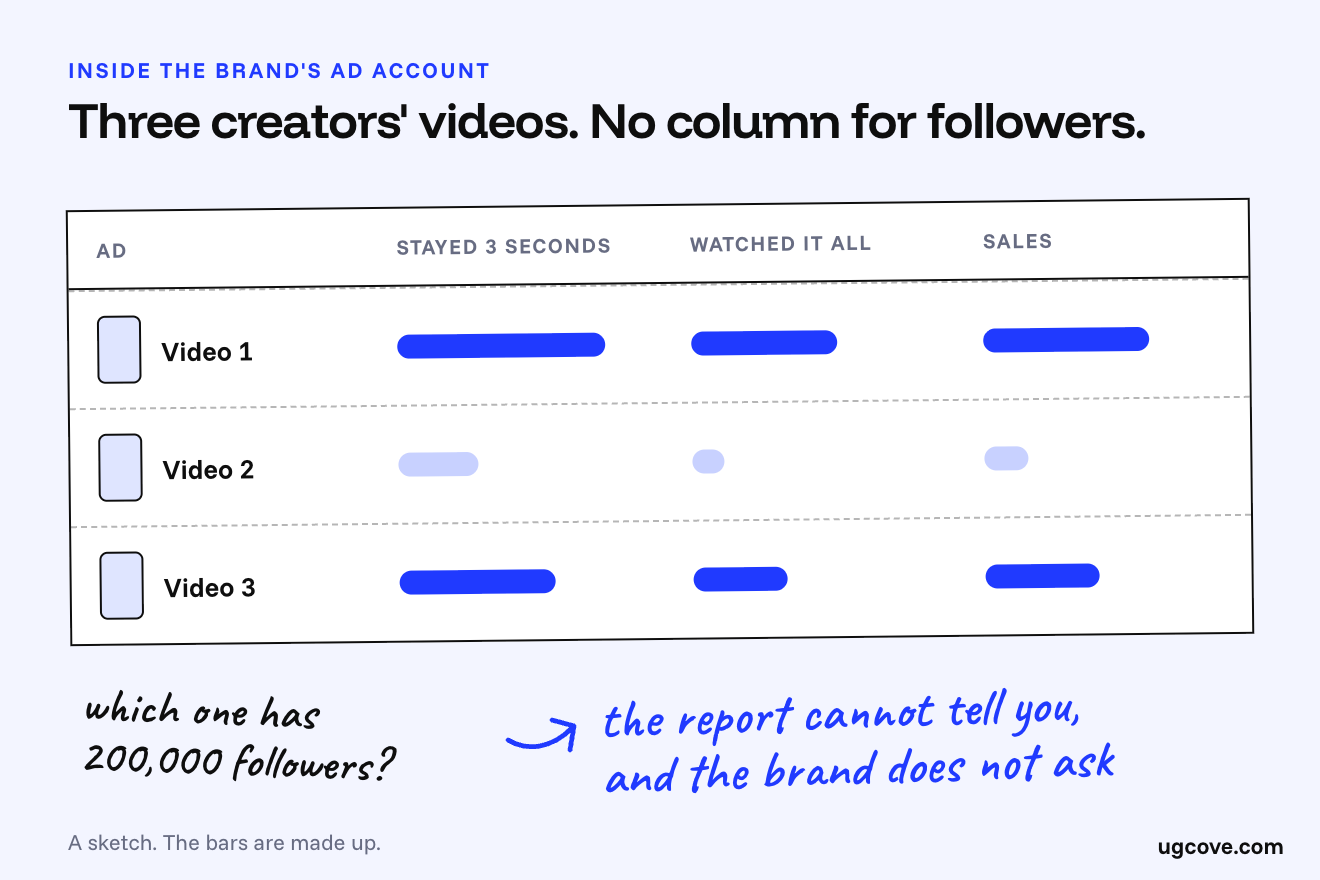
This is reasoning, not a test we ran. But it is how ad money works: the brand pays for every stranger the ad is shown to, so a video people watch makes that money go further than a video people skip. For a brand's ad budget, a creator with 200 followers and a video people watch is worth more than a creator with 200,000 and a video they skip. Not because small accounts are better. Because in an ordinary UGC job the account is not part of the deal.
None of this is a dig at big accounts. An influencer who is also good on camera makes a very good UGC creator. The followers do not hurt. They are just not what the ad tests.
What brands actually look for in a UGC creator
Billo says skill in scripting, delivery and basic editing “matters far more than follower count or professional gear”. That is a good list, but it is a little abstract. Here is ours: what we think a brand is checking when it watches your sample, roughly in the order it notices. It is our view, not an industry standard.
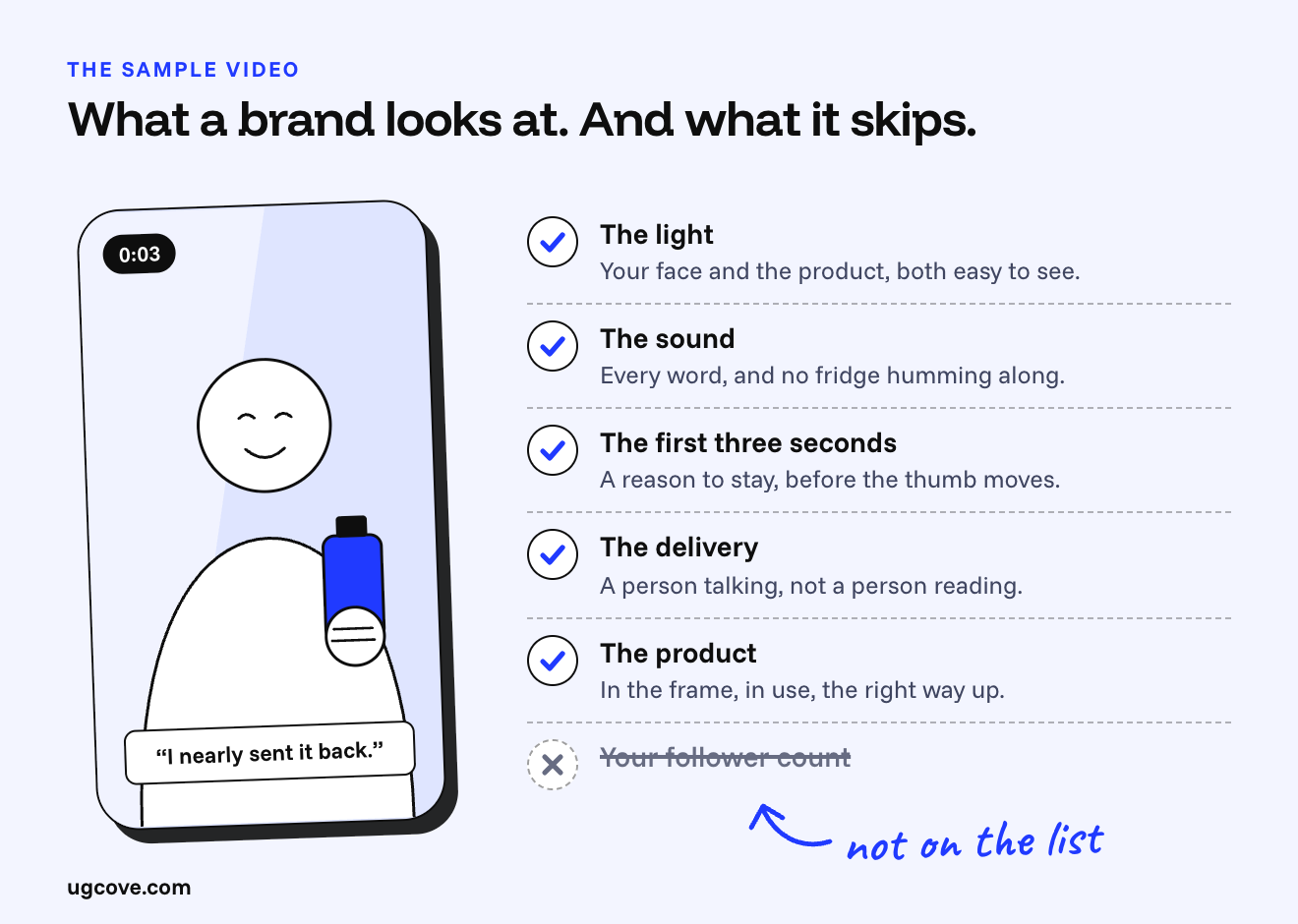
1. The light
Can the brand see your face and the product without effort? YouTube's filming advice is one line long: “try recording outside or using natural daylight through a window”. Face the window. If it is behind you, the brand is looking at a dark shape holding something.
Check yours: pause the video on any frame. Can you read the label on the product?
2. The sound
The same YouTube page says “good sound is a must”, and Google tells advertisers that sound in a Shorts ad “has been shown to increase conversions by over 20%”. A brand can fix a lot in the edit. It cannot fix an echo, a fridge or a road.
Check yours: listen once on headphones. Our tip: film in the room with the most soft things in it, which is usually the bedroom. And the wired earphones that came with a phone have a microphone on the cable, which sits a lot nearer your mouth than the phone does.
3. The first three seconds
TikTok's guidance for advertisers tells brands to “introduce your content proposition in the first 3 seconds” and to “prioritize your hook in the first 6 seconds”. Brands read pages like that one, and then they watch your sample. We think a video that opens with “hey guys, so today” has lost them before the product appears.
Check yours: watch only the first three seconds, then stop. Would you want the fourth?
4. The delivery
This is the robot problem. You can hear a script being read: the even pace, the eyes drifting to one side, the word “incredible”. TikTok tells brands to “go for a DIY or not overly polished style”, and a script read out loud is polish of the worst kind.
Check yours: learn the three points you have to make, put the script away, and film it a few times. Keep the take where you tripped over a word and carried on. That is the one that sounds like a person.
5. The product
In the frame, in use, the right way up, with the label facing the camera. It sounds too obvious to write down. It is also the first thing to go when you are concentrating on sounding natural.
Check yours: play the video with the sound off. Could a stranger tell what is being sold?
6. Whether you are easy to work with
This one is not on the screen. Did you follow the brief? Did you hit the date? Did you take the notes without arguing? We would guess a brand hires a creator the first time for the video, and the second time for this.
If you have no samples yet, our ten practice briefs train these one at a time, starting with the light.
When followers do matter
It would be a tidier post if the answer were never. It is not quite.
- When you are hired as an influencer. If the deal is that you post it to your own followers, the followers are the deal.
- When the brand runs the ad from your handle. TikTok's Spark Ads let a brand publish ads “using organic posts made by other creators (with their authorization)”. Instagram calls its version a partnership ad: “content a brand posts in collaboration with a creator”. Advertisers often call this whitelisting. Your name is on the ad, so a brand may well look at your account first.
- On some platforms' second route. Insense, for one, has a separate way in for creators who post on their own social accounts, and that one asks for at least 1,000 followers and 1,000 views.
Running an ad from your handle is an extra, and it is paid as one. We went through the going rates for it in what a UGC video really costs. If a brand asks for it, that is a second thing they are buying, not a favour.
What to show a brand instead of a follower count
If the number is not the pitch, something else has to be. This is what goes in its place.
- Three videos, three kinds. Say an unboxing, a piece to camera and a problem-then-product video. Three of the same thing shows one skill three times.
- Your best one first. Assume the brand watches one video, and not all of it.
- Clean files. Leave off the filters, the editing app's logo and the chart song. A brand cannot run an ad with music it has no licence for.
- One line about what you know. “I have had eczema for ten years” is worth more to a skincare brand than “12K on Instagram”.
- How fast you deliver. Say it, then do it.
As for the follower count: if it is small, there is no need to mention it. If it is big, mention it when the brand wants to use your handle, and not before. Leading with it tells the brand you think you are applying for the other job.
If you are the brand: how to choose without the number
The same list, from the other side of the table.
- Watch the first three seconds with the sound off. Then with it on. You are looking at light and hook, then listening for the room.
- Close your eyes for the middle. Does it sound like someone talking, or someone reading?
- Start with the video, not the profile. The profile is not what you are buying. If you plan to run the ad from their handle, look then.
- Send a small, exact brief. What comes back tells you whether they read it. Nothing on a profile page will.
FAQ: UGC creators, influencers and followers
What is the difference between a UGC creator and an influencer?
An influencer is paid to post to their own audience, so the brand is buying reach. A UGC creator is paid to make a video that the brand posts or runs as an ad from its own account, so the brand is buying the video.
Do you need followers to be a UGC creator?
No. Billo, Twirl, JoinBrands and soona all say so on their own pages, and UGCOVE has no follower minimum. Brands judge the sample videos. The exception is a platform's separate route for creators who also post on their own accounts, which can ask for 1,000 followers or more.
Do UGC creators post the video on their own account?
Usually not. The brand posts it or runs it as an ad. If a brand wants you to post it as well, or to run the ad from your handle, that is extra work and is normally paid as extra.
What do brands look for in a UGC creator?
Good light, clear sound, a strong first three seconds, a natural way of talking, and the product shown properly. After the first job: someone who follows the brief and delivers on time.
Can an influencer also be a UGC creator?
Yes, and many are. The skills overlap. The follower count just does not carry over, because the audience is not part of a UGC job.
Is UGC easier to get into than influencing?
It is quicker to start, because you do not have to build an audience first. It is not easier to do well. A video that holds a stranger for fifteen seconds takes work.
On UGCOVE there is no follower minimum, and you set your own rate. Applying takes about three minutes and three sample videos, and a person on our team watches every set. We are not open yet, so for now that means the waitlist.
The pages quoted in this post were read on 20 November 2026. We will update it when they change.