Stop making ads: how to edit content that feels native
A video that looks like an advert gets treated like one. Here is how to edit UGC so it belongs in the feed: the text, the sound, the room you film in, and the one thing native must never mean.
On this page
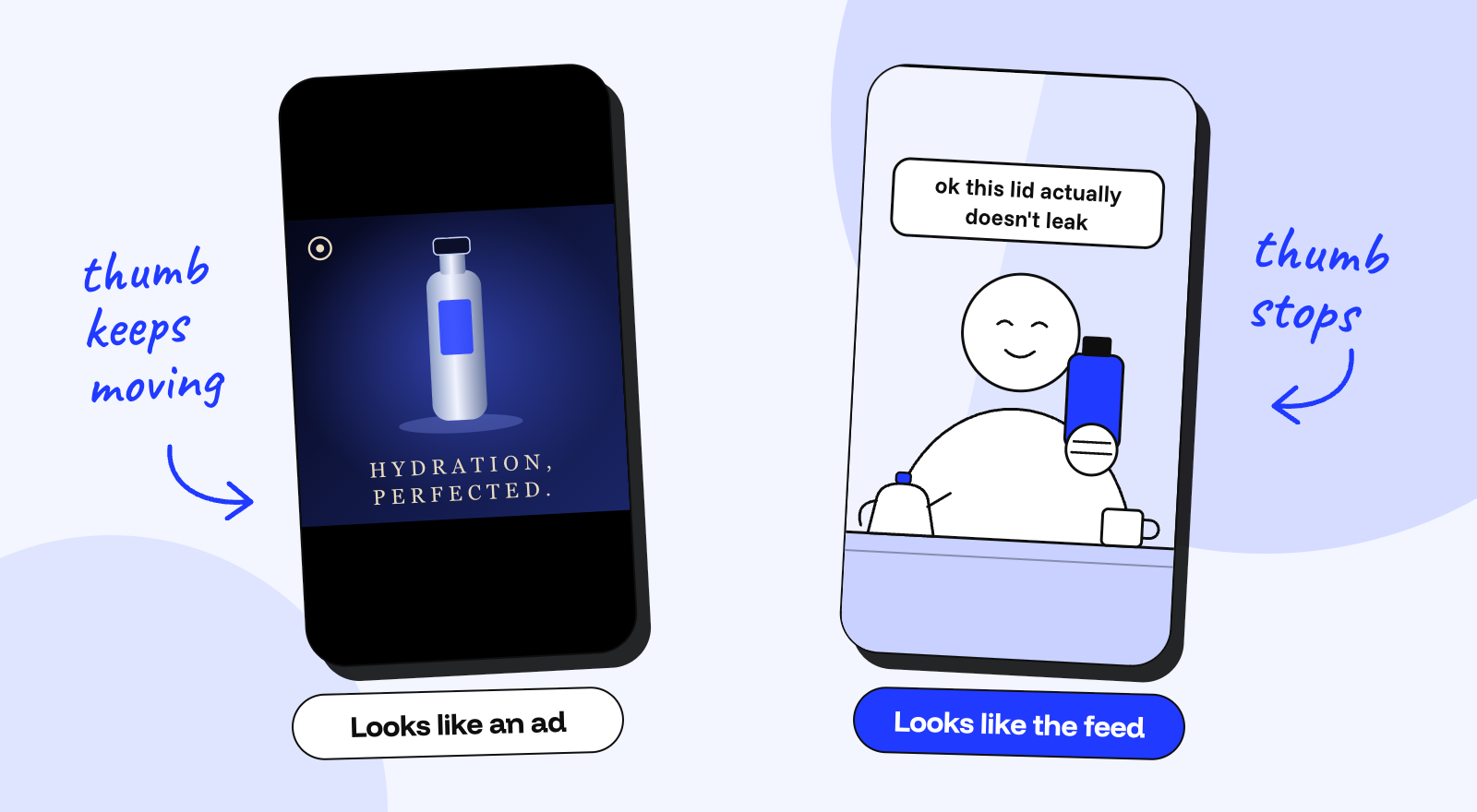
The video is lovely. Soft light, a slow move in on the bottle, a piano track, the brand's logo fading up in the corner. It took you most of a Sunday. In a feed, it lasts about as long as it takes someone to work out what it is.
People on TikTok and Reels are very good at spotting an advert, because they have had years of practice. A video that looks like one gets what adverts get, which is a thumb. This post is about the edit that avoids that: how to make a paid video look like it belongs in the feed, without pretending it is something it is not.
The short answer
- Native means it matches the feed. Upright, filmed on a phone, a person talking, plain text on screen.
- The platforms say this themselves. TikTok tells advertisers to “go for a DIY or not overly polished style”. Google's advice for YouTube Shorts is to make ads “that feel like they belong in the feed”.
- Nobody has published the clean test. We could not find a platform that put a polished video against a rough one and printed the result. What exists is advice and a couple of figures, given below with their limits.
- Text: use a plain style like the apps' own, keep it short, and keep it away from the edges.
- Sound: your own voice first. Borrow the shape of a trending sound, not the song.
- Room: film where the product is really used. Lived-in is fine. Distracting is not.
- Native is not low quality, and it is not hidden. Sharp picture, clear sound, true claims.
What does “native” content mean?
A native video looks and sounds like the videos around it. In a feed that is mostly people filming themselves on their phones, it is a person filming themselves on a phone. If you could drop it between two posts from ordinary accounts and nobody would feel a bump, it is native.
TikTok made a slogan of it. Writing in March 2026, it looked back: “Five years ago, when TikTok was still a new platform, we launched a simple idea: Don't Make Ads. Make TikToks.” It explained the line in a 2021 post for advertisers as “an invitation to be more creative, more authentic”, and was clear that it was not a ban: “we aren't actually telling brands not to make ads”.
- TikTok calls it TikTok-first: “Creating content that feels TikTok-first means taking a cue from the content that you love on your own For You Page.”
- Google studied Shorts ads and published the findings under the title “To stand out in the Shorts feed, make ads that blend in”. One of its headings: “Create ads that feel like they belong in the feed”.
So when a brief asks for “native”, “organic” or “lo-fi”, it is asking for this. It is also why brands hire UGC creators at all, as we covered in what brands actually look for in a UGC creator.
Why polished video gets scrolled past on TikTok and Reels
Our explanation is ours and not a platform's. Polish is how adverts have always looked, so polish is what people have learned to skip. Black bars, a colour grade, a logo, a designed font: each one says what this is before a word has been spoken.
Here is the same video made both ways.
| The advert | The native video | |
|---|---|---|
| Shape | Wide, with bars above and below | Upright, filling the screen |
| Camera | A big camera, background blurred | A phone, everything in focus |
| Opening | A logo or a title card | The product or the problem, already in the frame |
| Voice | A voiceover | You, talking |
| Text | The brand's font in the brand's colours | Plain text, like the apps' own |
| Sound | A track picked to sound expensive | Your voice and the room |
| Place | A studio, or a kitchen nobody cooks in | Where the product is really used |
| Ending | A logo, a slogan and a web address | The last useful sentence |
The platforms say much the same, which is more than you might expect from companies that sell advertising.
- TikTok, in that 2021 post: “Hyper-polished, aspirational content has been losing its shine.” Its creative guidance for advertisers gives the instruction in full: “In terms of aesthetics, go for a DIY or not overly polished style so that it fits in with the user-generated content on TikTok.”
- Google says its team “analyzed over 2,000 Shorts ads” to see what the successful ones shared. Two of its conclusions: “That DIY vibe better matches what viewers see elsewhere on Shorts, making it more likely to resonate”, and “A subtle, low-key tone works better than a sales pitch.”
There are a couple of numbers too. Each needs its small print.
- 74%. TikTok says “When brands make ads that are TikTok-first, 74% of viewers say they catch their attention.” That is from a 2022 study Ipsos ran for TikTok, and the page does not give the figure for other ads.
- 5% and 11%. Meta says that adding Reels-style video made by its partners to advertisers' usual campaigns “drove on average a 5% lower cost per result and an 11% higher conversion rate”, across 15 tests in 2022 and 2023. The usual campaigns used video that was not upright, so this tests made-for-Reels against not, rather than rough against polished.
Both come from companies with ad space to sell, and neither is the test you would really want: one polished video against one rough one, same product, same budget. So read this section's heading as what the platforms advise, not as a law. A brand whose whole appeal is polish may be right to keep it. For a product an ordinary person uses at home, the advice all points one way.
Native text: how to put words on the screen
Words on screen carry the video for people watching without sound, and tell a stranger what it is about. TikTok's advice is to “use captions or text overlays to provide context to your ad”. How the words look matters as much as what they say.
Use a plain style, like the apps' own
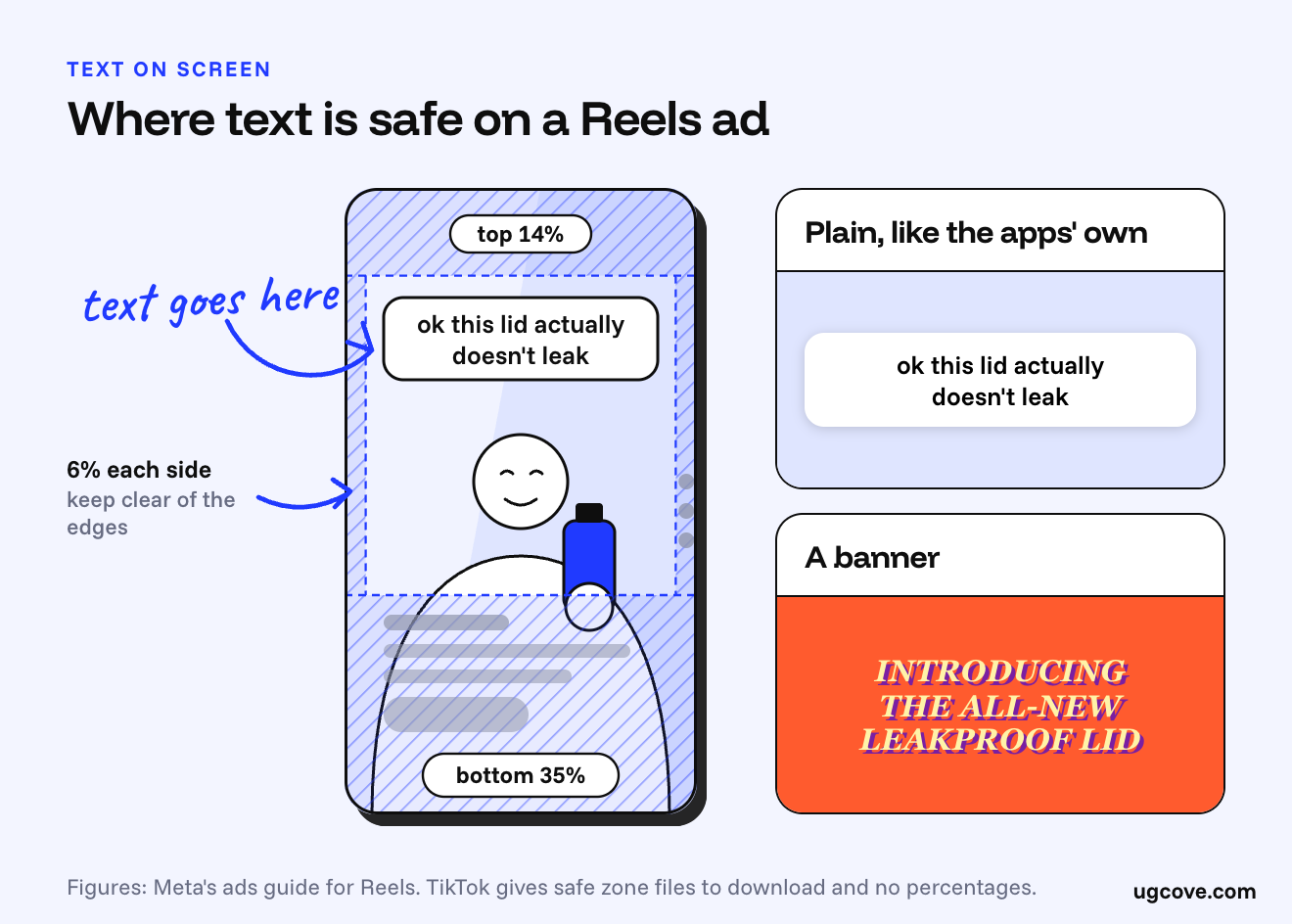
White letters, or black letters on a white box, in an ordinary sans-serif font. Most videos in the feed look like that, because it is what the apps hand everyone. A headline in the brand's typeface and colour is a banner, and people read it as one.
A brand usually wants the file, and text added inside TikTok or Instagram stays inside that app. So add the text in your editing app, in a plain style. If you can, send a second copy with no text, so the brand can add its own.
Write it the way you would text a friend
“ok this lid actually doesn't leak” is native. “INTRODUCING THE ALL-NEW LEAKPROOF LID” is a poster. Use sentence case, the first person, and words you would say out loud.
One thought at a time
Keep a line short enough to read at a glance, and leave it up long enough to read twice. Instagram's guidance for creators asks for videos “where text does not cover the majority of the screen”, which is a good rule for a paid video too.
Keep it out of the edges
The apps lay the caption, the account name and the buttons over your video, and text placed under them is hidden. Meta gives figures for a Reels ad: “Consider leaving roughly 14% of the top, 35% of the bottom, and 6% on each side of your asset free from text”. TikTok gives no percentages on the page we read. It offers safe zone files to download, and a plain instruction: “save space on screen for the TikTok UI.”
Captions for what you say out loud are a separate job. We covered those in the 3-second rule.
Sound: borrow the shape of a trending audio, not the song
The platforms want sound. Google's advice for Shorts ads is to “use sound (music, voiceover, or both)”, which it says “has been shown to increase conversions by over 20%”, though it names no study. TikTok tells advertisers to “lean into trends to make your ads feel more relevant and engaging”.
For a creator filming for a brand, there is a catch, and it is about rights.
Why you usually cannot use the trending song
A video you make for a brand is commercial, and the songs in the apps' main libraries are mostly licensed for personal use. TikTok's page on its Commercial Music Library says so directly: “Businesses cannot use the general music library for commercial usage.” YouTube says its agreements with some music partners “restrict use of music in Shorts to personal and non-commercial uses”.
Someone else's original sound is no way round it. TikTok tells businesses that want to use “original sound from other users” to “consult your legal team to ensure you have obtained a proper license”. So a video a brand will run as an ad should carry neither the song of the week nor another creator's audio.
What a trending sound is made of
This part is ours, from watching a lot of them. Most sounds that spread have three parts. A setup creates a question. Then comes a turn: the beat drops, the voice pauses, the punchline lands. Then a payoff shows what the setup promised. People cut their reveal to land on the turn. That timing is why the format works, and nobody owns it.
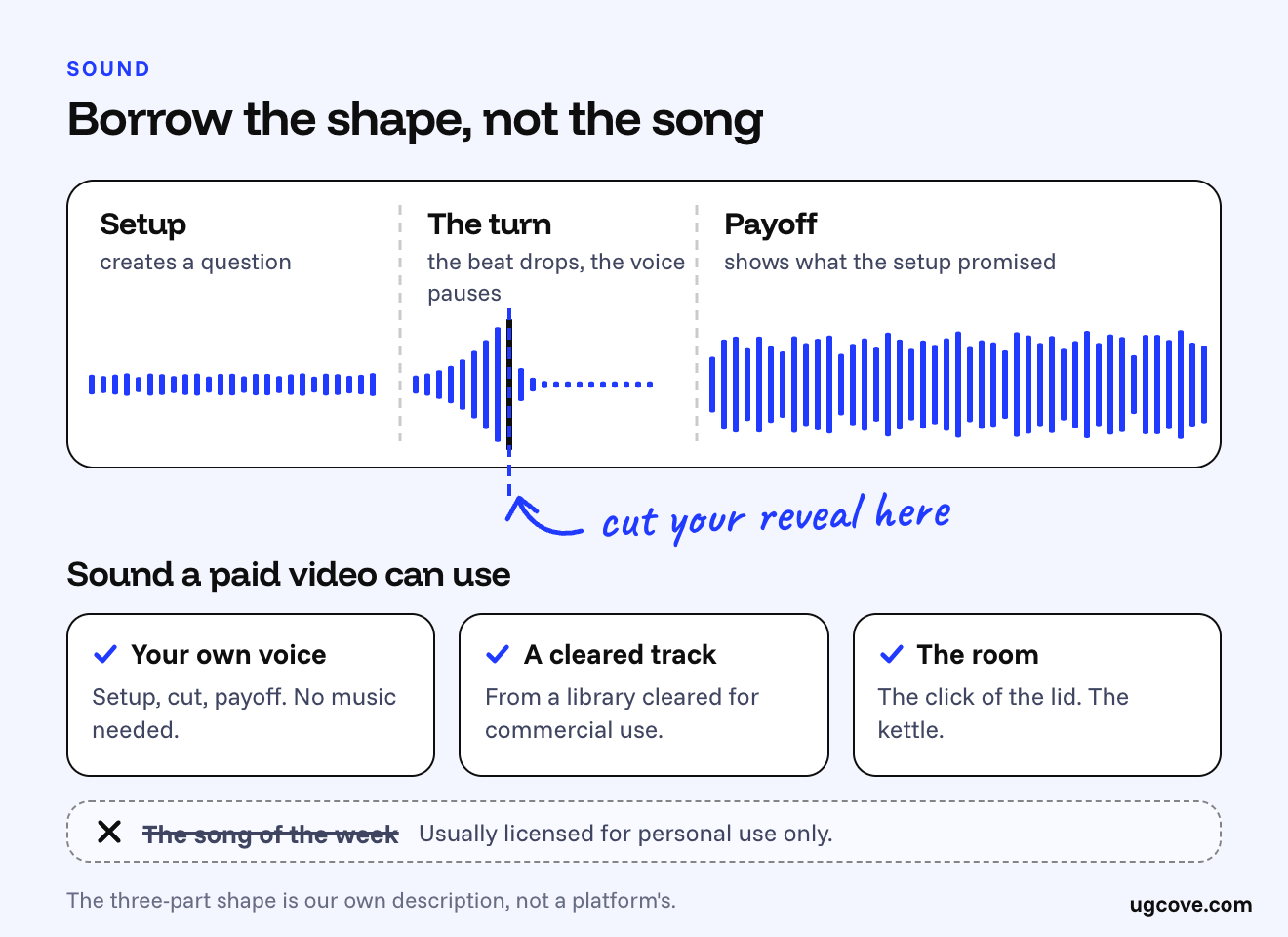
So use the shape with sound you are allowed to use.
- Do it with your own voice. “I have bought four of these and every one leaked.” Cut. The new one, upside down over your bag, not leaking. Setup, turn, payoff, and not a note of music.
- Use a list beat. Three quick things, one cut on each. “Fits the cup holder. Goes in the dishwasher. Has not leaked since March.”
- Use a format, not a song. Answering a comment, or a before and an after. These outlast any one sound.
- Cut to a cleared track. If the brief wants music, pick it from a library cleared for commercial use. TikTok describes its own as “a pre-cleared global music library” that is “free for businesses to use”. Then put your cuts on its beat.
Trends also go off quickly, and a brand may run your video for months. Keep any music well under your voice, and if you can, send a second copy with none.
Where to film: rooms that look lived in
Film the product where it is used. The pan on the hob. The serum on the bathroom shelf. The pillow spray on a bed that has been slept in. Google's advice for Shorts is to “show talent using the product” and to “give real people a real stage to share their own POV”. Nobody's kitchen is a white studio, and a viewer knows it.
This is where the advice about messy bedrooms and kitchen counters comes from, and it is mostly right. A mug by the kettle, a charger on the worktop, a jumper over the chair: these tell the viewer that a person lives here and really uses the thing.
But lived-in and distracting are different, and the viewer's eye still has to land on the product. So before you film, sort the room into two lists.
- Leave it: the ordinary things that belong in that room. The kettle, the dish rack, the plant, the unmade corner of the bed.
- Move it: other brands' labels, above all a competitor's. Anything with your name or address on it, such as a parcel. Anything standing between the camera and the product.
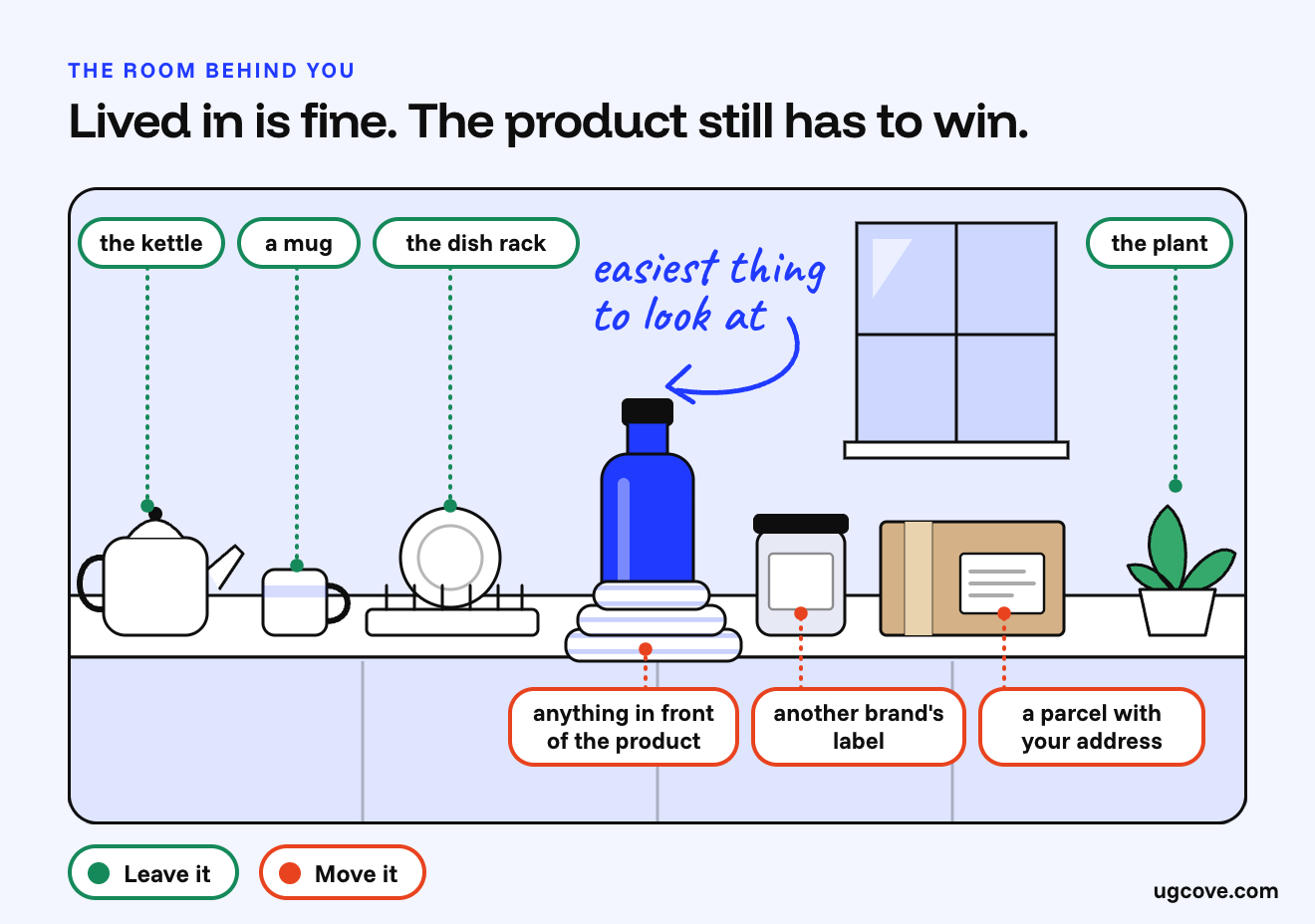
Do not fake the mess: clutter that has been arranged looks arranged. And light still matters. Face a window, as we said in the kit list for our ten practice briefs. A dark video is not more real, only harder to watch.
Native is not the same as low quality
Lo-fi describes the style. It does not excuse the picture. Instagram tells creators: “Don't post reels that are visibly from other apps (i.e. contain watermarks) or that are low quality.” The same page asks for “high-resolution, 9 x 16 vertical videos with no borders”.
- Keep: a clean lens, a sharp picture that fills the screen, and sound where every word is clear. Export without the stamp your editing app adds.
- Drop: filters and colour grades, spins and swooshes, a logo animation at the start, a slogan card at the end, and slow motion of the product turning in the light.
The cutting itself is covered in the 3-second rule: the opening, dead air, filler words and jump cuts.
Native is not the same as hidden
Marketers have a name for why this style works: the trust economy. We could not find one person who owns the phrase, so take it as a loose idea. People believe other people more than they believe adverts. Nielsen asked more than 40,000 people around the world in September 2021 and reported that “88% of global respondents trust recommendations from people they know more than any other channel.”
Read that figure carefully. It is about people they know, and a stranger in a paid video is not that. A UGC video borrows the look of a friend's recommendation. A viewer who feels tricked does not only scroll. They stop believing the next creator as well.
So an advert that feels native is still an advert. What that means depends on where it runs.
- On the brand's own account. The UK's advertising regulator says all advertising has to be “obviously identifiable”, and that content on a brand's own account “is generally considered to be obviously identifiable as advertising for that brand.” Your job here is the honesty of what you say.
- On your own account. Now you are the one publishing it. TikTok: “When posting content that promotes a brand, product, or service on TikTok, you must turn on the commercial content disclosure setting.” Instagram: “If you're getting paid in any form for your content, you'll need to add a Paid Partnership label.”
- Whatever you say about the product. The US Federal Trade Commission, in its guide for people who post for brands: “You can't talk about your experience with a product you haven't tried.” And: “If you're paid to talk about a product and thought it was terrible, you can't say it's terrific.”
Rules like these differ by country. India's advertising body, ASCI, asks that a disclosure be “upfront and prominent so that it is not missed by an average consumer”. Most are written with influencers in mind, and none of this is legal advice. If you are unsure, ask the brand.
For a creator it comes down to this: use the product before you film it, say what happened to you and not what the packaging promises, and never cover a label the platform adds.
Four ways “native” goes wrong
The staged mess. A single sock placed on a tidy bed. People can tell, and then the whole video looks arranged.
The trend that does not fit. A dance for a tax app. The viewer remembers the dance, and it is out of date before the ad stops running.
The song you cannot use. It sounds perfect, and it can get the brand's ad taken down.
Pretending it is not an ad. Fake surprise, a made-up result, a hidden label. This one does lasting harm, to you and to every creator after you.
If you are the brand: how to brief for native
- Send points, not a script. Say what must be shown and what must be true. A creator reading your sentences word for word sounds like an advert.
- Leave the brand book out of it. No brand font, no logo in the corner. The logo is on the product, and the product is in their hand.
- Say where the video will run, and for how long. It decides the music, the trend and the disclosure. It is also part of the price, as we showed in what a UGC video really costs.
- Ask for the clean copies. One without text, one without music, and the raw clips. Then you can recut for each platform.
- Run the test nobody has published. Same product, same budget, one native video and one polished one. Your own result is worth more than any figure in this post.
FAQ: editing UGC that feels native
What is native content?
Content that looks and sounds like the ordinary videos around it in the feed: upright, filmed on a phone, a real person talking, plain on-screen text. TikTok calls it TikTok-first, and Google's advice for Shorts is to make ads that feel like they belong in the feed.
Do polished ads perform worse on TikTok and Reels?
The platforms advise against polish. TikTok tells advertisers to “go for a DIY or not overly polished style”, and Google says a DIY feel is “more likely to resonate” on Shorts. We could not find a platform that has published a direct test of a polished video against a rough one, so treat it as strong advice and not a proven rule.
Can I use a trending sound in a UGC video for a brand?
Usually not the song itself. TikTok says businesses “cannot use the general music library for commercial usage” and points them to its Commercial Music Library. Use your own voice, a track cleared for commercial use, or the structure of the trend without its audio.
Where should text go on a TikTok or a Reel?
In the middle of the frame, clear of the edges. For a Reels ad, Meta suggests keeping roughly the top 14%, the bottom 35% and 6% on each side free of text. TikTok offers safe zone files to download.
Does a UGC ad have to say it is an ad?
If you post a paid video on your own account, yes: TikTok and Instagram both require you to switch on their disclosure label. When the brand runs it from its own account, the labelling is the brand's job. Either way, what you say has to be true and your own experience.
What is the trust economy?
A loose marketing term for the idea that people believe other people more than they believe advertising. Nielsen's 2021 survey found that 88% of people trust recommendations from people they know more than any other channel. Native video borrows some of that trust, so honesty in it matters.
When you apply to UGCOVE, a person on our team watches your three sample videos. Videos that look like they belong in a feed are what we hope to see. There is no follower minimum, and the form takes about three minutes. We are not open yet, so for now applying means joining the waitlist.
The pages quoted in this post were read on 24 November 2026. We will update it when they change.